The Dental Labor Squeeze
Why staffing shortages affect appointment access, continuity, and chair time in UAE dental practices
8-slide carousel · storyboard copy
The Dental Labor Squeeze
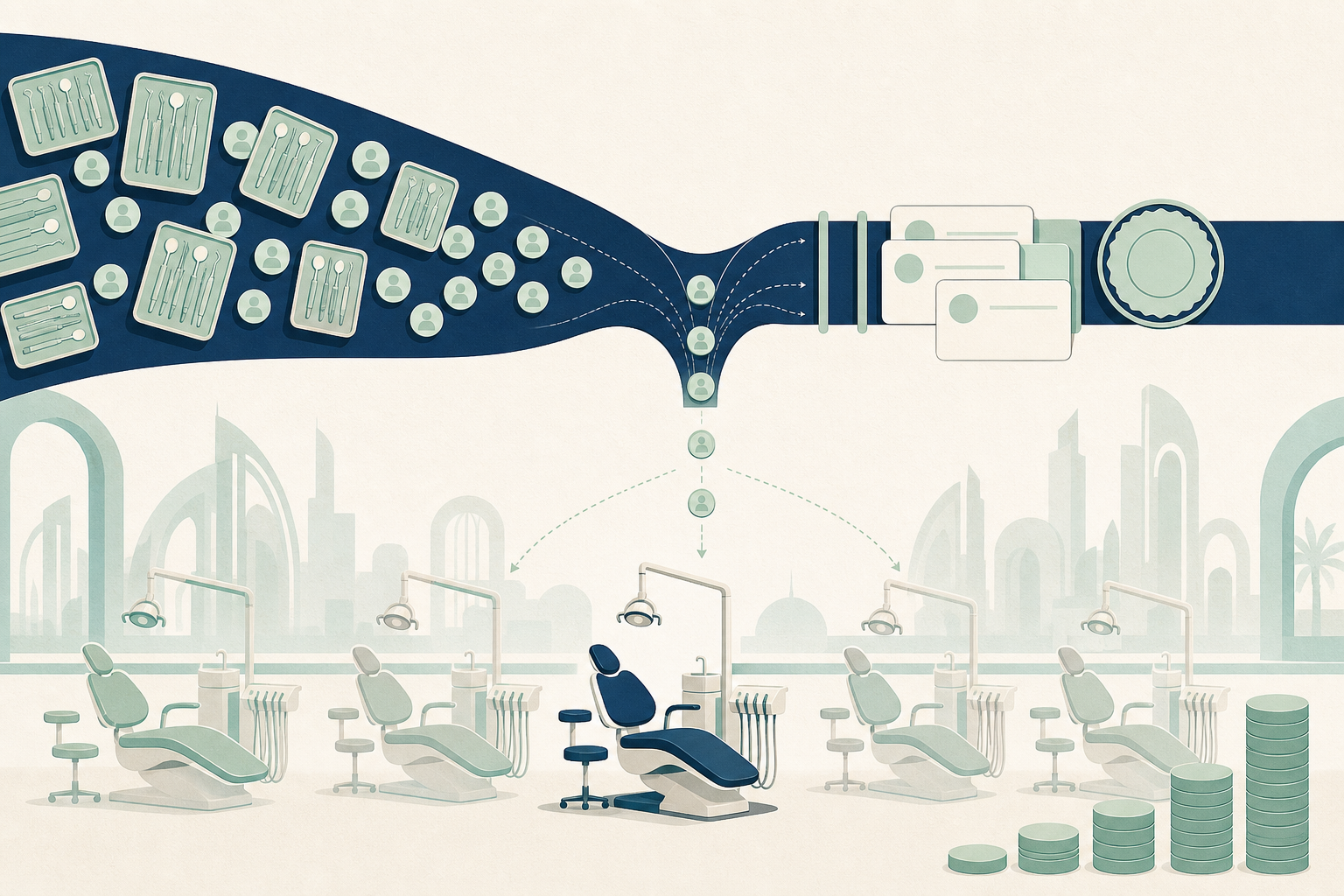
A shortage of hygienists, dentists, dental assistants, and licensed support staff can limit how many patients a practice safely treats. The effect is practical: fewer appointment slots, longer waits, and more pressure on each clinical session.
Why it matters to patients
A dental visit depends on a coordinated team. The dentist examines teeth, gingiva, periodontal pockets, occlusion, and oral mucosa. The dental assistant prepares instruments, suction, isolation, materials, and infection-control barriers. A hygienist or dentist may perform periodontal debridement, polishing, fluoride application, and oral-hygiene instruction. If one role is missing, the practice may shorten sessions, combine appointments, or delay preventive care.
- Licensing rules determine who may diagnose, treat, take radiographs, or provide preventive procedures.
- Visa processing and credential verification can delay recruitment of qualified clinicians.
- Higher wages can increase operating pressure without creating more clinical hours.
- A full schedule is useful only when staffing, sterilization, room turnover, and clinical supervision remain safe.
How practices keep chairs functioning
Well-run groups usually combine several staffing methods while keeping diagnosis and treatment within each clinician's legal scope.
- Use dental assistants for four-handed dentistry, suction, retraction, tray setup, instrument transfer, and room turnover.
- Reserve dentist time for examination, diagnosis, treatment planning, local anaesthesia, tooth preparation, periodontal assessment, and procedures requiring a licensed dentist.
- Use hygienists or appropriately licensed clinicians for periodontal charting, supra- and subgingival instrumentation, polishing, fluoride varnish, and tailored home-care instruction.
- Standardise trays and materials: mouth mirror, explorer, periodontal probe, ultrasonic scaler tips, hand curettes, high-volume suction, cotton rolls, rubber dam equipment, composite instruments, bonding agent, light-cure unit, and finishing discs.
- Use recall systems to bring patients back for risk-based preventive care rather than waiting for pain or fracture.
The one rule that matters
Staffing efficiency must never replace clinical judgment or infection control. Every patient still needs identity verification, medical-history review, appropriate radiographs when indicated, diagnosis by an authorised clinician, instrument sterilization, surface disinfection, hand hygiene, personal protective equipment, and a documented treatment plan.
- Ask who is providing each procedure and whether that person is licensed for it.
- A dental assistant may support treatment but does not independently diagnose decay or prescribe treatment.
- Do not accept a rushed visit that omits examination, consent, isolation, sterilization, or aftercare instructions.
Mythbuster: a shorter visit is not automatically better
A streamlined appointment can be safe when the sequence is planned. It becomes unsafe when steps are removed. For a posterior composite restoration, the clinical sequence may include caries removal, matrix placement, acid etching, rinsing and controlled drying, bonding, incremental composite placement, light curing, occlusal adjustment, finishing, and radiographic review when indicated. Skipping moisture control or curing can weaken the restoration even if the visit feels efficient.
- Efficiency means reducing idle time, not removing diagnostic or clinical steps.
- A faster schedule cannot compensate for untreated periodontal inflammation, recurrent caries, or an uncorrected bite problem.
- Ask for an explanation if the proposed treatment changes from the examination findings.
Make your care plan work for you
Your risk profile should determine the interval and type of care. A patient with deep periodontal pockets, bleeding on probing, diabetes, smoking exposure, xerostomia, orthodontic appliances, or frequent sugar exposure may need closer monitoring than a low-risk patient.
- Use an interdental brush when the space allows the brush to contact both tooth surfaces without force.
- Use floss where the contact is tight or an interdental brush cannot pass comfortably.
- Brush twice daily with fluoride toothpaste, spit after brushing, and do not rinse with water immediately afterward.
- Clean around implant crowns, bridges, braces, and retainers using the devices recommended for their design.
- Tell the practice about pregnancy, anticoagulants, diabetes, allergies, dry mouth, and previous reactions to local anaesthesia.
When to see a dentist promptly
Do not wait for staffing availability when symptoms may indicate infection, trauma, or progressive disease. A dentist should assess the cause, examine the relevant anatomy, and decide whether radiographs, pulp testing, periodontal measurements, drainage, restoration, extraction, or referral is needed.
- Facial swelling, fever, difficulty swallowing, difficulty breathing, or rapidly worsening pain requires urgent care.
- A knocked-out permanent tooth needs immediate dental assessment. Keep it moist in milk or saline and avoid scrubbing the root.
- Persistent bleeding after an extraction, a loose permanent tooth, or a fractured restoration needs review.
- Sensitivity that lingers after hot or cold stimuli can indicate pulpal inflammation and should be examined.
- A sore, lump, ulcer, or red or white patch lasting more than two weeks needs professional assessment.
Know what safe capacity looks like
The dental labor squeeze is a workforce problem, but patient safety remains the boundary. Choose a practice that explains who is treating you, uses licensed staff, maintains sterilization, records findings, and gives you a clear sequence of care. Book preventive care early, and contact Dental Nation to arrange an evidence-based assessment.
- Bring your medication list and previous dental records.
- Ask what will be examined, what materials will be used, and what follow-up is needed.
- Use Dental Nation for a structured plan based on your teeth, gingiva, bite, medical history, and risk factors.