The Oral Microbiome and What Disrupts It
A healthy mouth is not sterile. It is a changing microbial community held in balance by saliva, the oral lining, tooth surfaces, immune defenses and daily hygiene. This report explains how that balance shifts toward gingivitis, caries and periodontitis, and what clinicians and patients can do at the chair and at home.
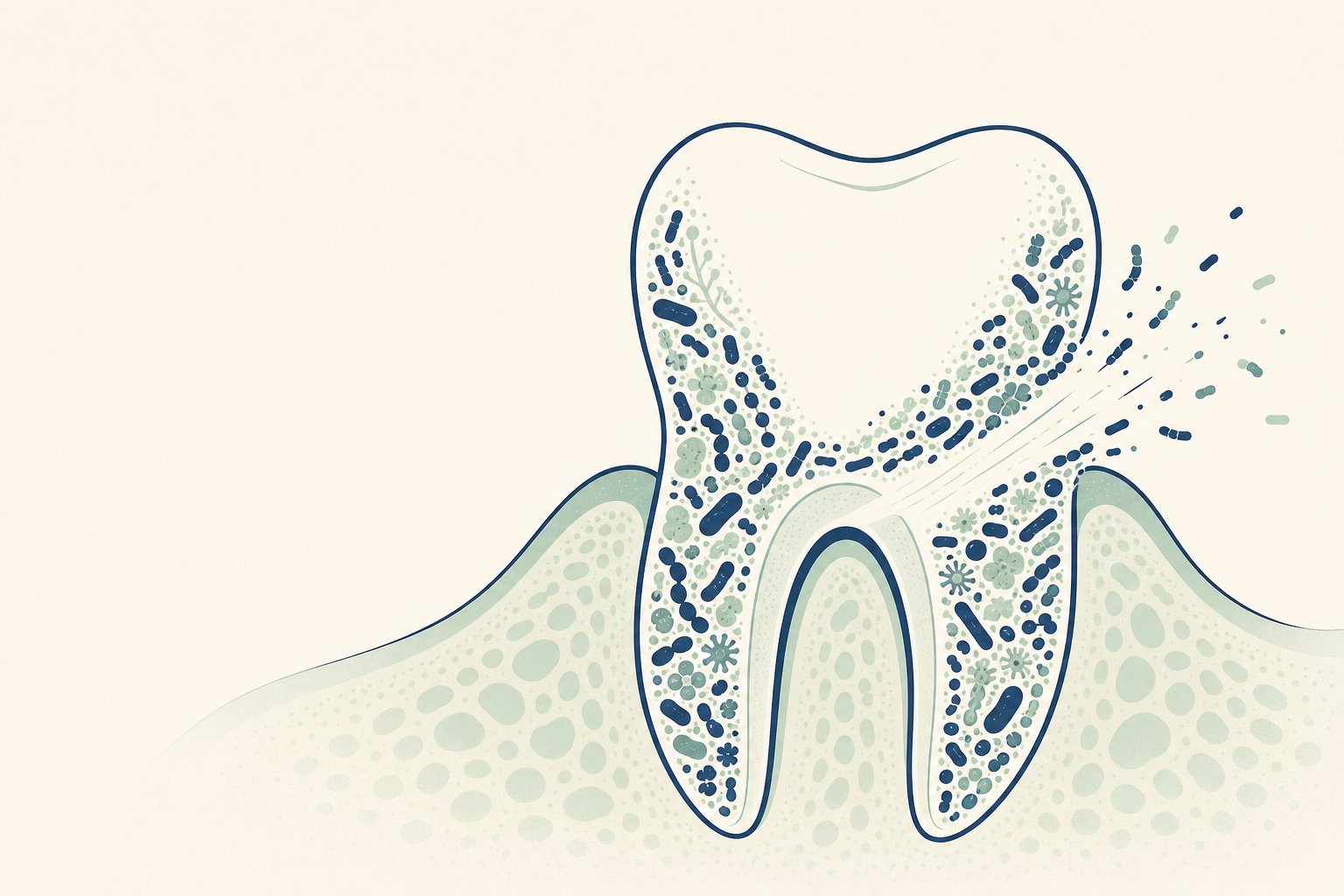
A healthy mouth is a managed ecosystem, not a sterile surface
The mouth contains bacteria, fungi, viruses and other microorganisms living on the tongue, cheeks, gums, saliva and tooth surfaces. Most are harmless in the conditions created by a healthy mouth. They form biofilm, a structured community attached to enamel, dentine, restorations and soft tissue. Biofilm is not simply a layer of dirt that can be removed permanently. It is a living film that develops again after cleaning. The clinical goal is therefore not to sterilise the mouth. Sterilisation would be impossible in daily life and would not be necessary for health. The goal is a balanced biofilm in which microbial activity, saliva, host immunity and mechanical cleaning remain compatible with healthy gingiva and stable tooth surfaces. Saliva supplies calcium and phosphate, buffers acids and helps clear food debris. The gingival barrier and immune response limit invasion. Regular toothbrushing and interdental cleaning disrupt mature deposits before they become more difficult to control. This distinction changes the message patients hear. A mouth can contain many microorganisms and still be healthy. Conversely, a mouth can look clean for a short time while an undisturbed biofilm is already changing at the gum margin. The relevant question is not whether bacteria are present. It is whether the local conditions are selecting for inflammation, acid production or tissue breakdown.
The target is a balanced biofilm, not a sterile mouth.
What changes when plaque remains undisturbed
Early plaque is often dominated by organisms that tolerate oxygen and attach to the acquired pellicle, the protein film that forms on enamel soon after cleaning. As plaque thickens, oxygen becomes less available and the community changes. Food remnants, reduced saliva flow, frequent sugar exposure and gum inflammation can alter the local environment further. The result is not one single harmful bacterium appearing in isolation. It is a shift in the behaviour and composition of the community. At the gingival margin, bacterial products stimulate the host immune response. Blood vessels become more permeable, immune cells enter the tissue and the gingiva may appear red, swollen or prone to bleeding. Bleeding is a sign of inflammation, not proof that cleaning has injured the gums. If plaque control improves, gingival inflammation can usually be reduced because the trigger is being removed. Below the gum, a periodontal pocket can provide a protected, low-oxygen space where deposits are harder to disrupt. In susceptible patients, persistent inflammation can damage the periodontal ligament and alveolar bone. The important clinical sequence is therefore plaque retention, local inflammation, pocket formation and progressive tissue damage in some patients, not an automatic progression in every mouth. Risk factors such as smoking, diabetes, medication-related dry mouth and poor access for cleaning can change that trajectory.
Periodontal disease develops through a host and biofilm interaction, not from one germ acting alone.
Saliva, sugar and pH decide which activity is favoured
Saliva is one of the mouth's main stabilising systems. It lubricates the tissues, clears carbohydrates, buffers acids and delivers minerals that support enamel repair. A dry mouth reduces these protective effects. Causes include dehydration, mouth breathing, many medicines, radiation treatment, some systemic diseases and reduced salivary gland function. Patients with dry mouth may notice sticky tissues, difficulty swallowing dry food, frequent sipping, altered taste or a higher rate of cervical and root caries. Sugar frequency matters because each fermentable carbohydrate exposure can lower plaque pH. The critical issue is repeated acid challenge throughout the day, especially when snacks or sweetened drinks are consumed slowly. Enamel loses mineral when the surrounding fluid remains acidic. Saliva can help return conditions toward neutrality and support remineralisation, but it cannot fully compensate for constant exposure. At the chair, the practical response is to ask about the timing of meals, drinks, sports beverages, medicines and nocturnal symptoms, not only about the amount of sugar consumed. Clinicians should inspect exposed root surfaces, plaque-retentive margins, erosion patterns and the quality of saliva. Patients can reduce repeated sugar exposure, choose water between meals, follow an appropriate fluoride routine and seek assessment when dry mouth is persistent. The aim is to change the conditions that select for acid-producing activity.
Microbial balance is shaped by the environment around the biofilm.
Gum disease is an inflammation problem with a microbial trigger
Gingivitis is inflammation confined to the gingiva. It commonly presents with bleeding during brushing or interdental cleaning, swelling, redness and changes in contour. The first treatment is usually improved disruption of plaque at the gum margin and between teeth, supported by professional removal of calculus where needed. A patient may see more bleeding briefly when previously neglected areas are cleaned, but consistent gentle cleaning should reduce inflammation over time. Periodontitis is different. It involves loss of attachment and supporting alveolar bone. It cannot be diagnosed from bleeding alone. Diagnosis requires periodontal probing, assessment of pocket depths and clinical attachment, evaluation of recession and mobility, and radiographs when indicated. The microbial community contributes to the inflammatory challenge, but tissue destruction is also determined by the patient's immune response and risk profile. Treatment therefore has two linked targets. The first is biofilm control through home care and professional instrumentation. The second is risk control, including smoking cessation, diabetes management, correction of plaque-retentive factors and review of medicines or conditions that affect the mouth. Scaling and root surface debridement can remove calculus and disrupt subgingival deposits, but it does not make the mouth sterile. Maintenance appointments matter because pockets, furcations, crowded teeth, overhangs and implants can remain difficult for patients to clean fully.
The diagnostic question is not simply whether gums bleed, but whether supporting tissue has been lost.
The dental materials around a tooth can help or hinder biofilm control
Biofilm adheres to natural enamel and dentine, but it also accumulates on restorative materials. A well-contoured, polished composite margin can be compatible with good plaque control. An overhanging filling, rough temporary crown, open contact, defective crown margin or excess cement can create a sheltered area that a toothbrush cannot clean effectively. The problem is mechanical access as much as bacterial identity. The same principle applies to orthodontic brackets, bonded retainers, dentures and implant components. Around implants, plaque can inflame the peri-implant mucosa. Persistent inflammation may progress to peri-implantitis with supporting bone loss in susceptible cases. Implant surfaces and threads also make home cleaning technique and professional maintenance especially important. At the chair, clinicians should inspect margins with an explorer, assess contacts and contour, remove residual cement, polish or replace defective restorations when indicated, and select cleaning aids that fit the anatomy. A patient with a bridge may need an interdental brush or specialised threader. Where an open embrasure allows it, an interdental brush is generally preferable because it contacts the tooth surfaces more effectively. Floss remains useful where the contact is tight or where the anatomy requires it. The material is not the sole cause of disease. Its shape, surface and accessibility determine how easily the patient can disrupt the biofilm.
A restoration is part of the patient's cleaning environment.
Antiseptic products have a limited role, and antibiotics are not routine plaque control
Mechanical disruption remains the foundation of biofilm control. Toothbrushing with fluoride toothpaste removes deposits from accessible surfaces and delivers fluoride to enamel. After brushing, patients should spit and not rinse with water, so less fluoride is washed away. Interdental brushes, floss and other aids address surfaces a toothbrush misses. Antiseptic mouthrinses may be useful for selected short-term indications, such as when a patient cannot brush an area after surgery or when a clinician prescribes a product for a defined reason. Chlorhexidine can cause staining, taste disturbance and increased calculus in some users, so it should not be treated as a routine daily substitute for cleaning. Essential-oil rinses may reduce plaque and gingivitis as an adjunct, but they do not remove the need for brushing and interdental cleaning. Alcohol content should be discussed in relation to dryness and tolerance. It is not accurate to tell patients that alcohol mouthwash causes cancer. Systemic antibiotics do not replace local plaque control and are not routine treatment for ordinary gingivitis. They may have a role in specific infections or selected periodontal situations under professional assessment. Products such as charcoal whitening should not be presented as proven treatment for oral disease or as a reliable method of whitening. The practical question is always what problem the product is intended to solve and whether it addresses the underlying mechanism.
A rinse can be an adjunct. It is not a substitute for disrupting plaque.
What research supports, and what it does not yet justify
Research supports the central role of biofilm disruption, fluoride exposure, saliva protection and periodontal risk management. It also supports a patient-specific approach. The same plaque level can produce different outcomes in different people because smoking, diabetes, immune response, medication, anatomy and previous attachment loss influence risk. The strongest chairside decisions therefore begin with examination and history rather than with a universal microbiome product. Research does not yet justify promising patients that a commercial probiotic, microbiome test, supplement or special toothpaste can reliably prevent periodontitis or rebuild lost bone. Such approaches may be investigated as adjuncts, but they should not displace established care. The presence of a named organism in a test does not by itself establish that it caused a patient's disease or that eliminating it will restore health. Hydroxyapatite products may have a role in remineralisation or sensitivity management, depending on the formulation and evidence for the indication. They should not be described as equivalent to fluoride. Mouth taping should not be recommended as a routine oral health intervention, particularly where nasal obstruction, sleep-disordered breathing, vomiting risk or anxiety is present. For Dental Nation clinicians, the evidence-based message is direct: assess the patient's anatomy and risk, remove or reduce plaque-retentive factors, use fluoride appropriately, manage inflammation and review the response over time.
A microbiome label is not a diagnosis, and a new product is not automatically a better treatment.
The chairside plan is to change conditions, then measure response
A practical consultation starts with the patient's symptoms and daily pattern. Ask about bleeding, bad taste, dry mouth, snacking, sweetened drinks, smoking, diabetes, medicines, orthodontic appliances, dentures and implant care. Examine plaque distribution, gingival inflammation, calculus, restorations, contacts, pocketing, recession, mobility and exposed root surfaces. Take radiographs when they will answer a clinical question, such as suspected bone loss or recurrent caries. The plan should be specific. Demonstrate the angle and pressure for brushing along the gingival margin. Select an interdental brush size that enters with gentle resistance where the gap allows. Use floss for tight contacts or areas where it is the appropriate tool. Address rough or overhanging restorations and remove calculus professionally. Recommend fluoride toothpaste and advise the patient to spit rather than rinse after brushing. If dry mouth is present, review causes, hydration, saliva substitutes or stimulants when appropriate, and caries prevention. Review is part of treatment. Record bleeding, plaque control, pocket measurements, caries activity and patient-reported symptoms. If inflammation persists, investigate missed deposits, inaccessible anatomy, smoking, glycaemic control, medication effects or an incorrect diagnosis. The report's argument is simple: oral microbiome care is not about chasing sterility. It is about creating conditions in which health is easier to maintain and disease is detected before avoidable damage accumulates.
Change the local conditions, then measure whether the tissues respond.
Key findings
- The healthy oral state is a balanced microbial community, not a sterile mouth.
- Undisturbed biofilm can drive gingival inflammation, acid activity and, in susceptible patients, periodontal tissue destruction.
- Saliva protects teeth and tissues by clearing food, buffering acids and supplying minerals.
- Frequent sugar exposure, dry mouth, smoking, diabetes and plaque-retentive anatomy can shift the local conditions toward disease.
- Mechanical plaque disruption remains the foundation of prevention and treatment.
- Interdental brushes are generally preferable where the space allows, while floss remains appropriate for tight contacts and selected anatomy.
- Antiseptic rinses, probiotics, microbiome tests and supplements should be presented as limited or investigational adjuncts unless supported for a specific indication.
- Hydroxyapatite should not be described as equivalent to fluoride, and charcoal whitening should not be presented as proven.
- After brushing, patients should spit and not rinse with water.