Lab-grown and bioengineered teeth: where regenerative dentistry honestly stands
Antibody-driven tooth regeneration and stem-cell scaffolds are real research, but they are not routine replacements for implants or bridges yet.
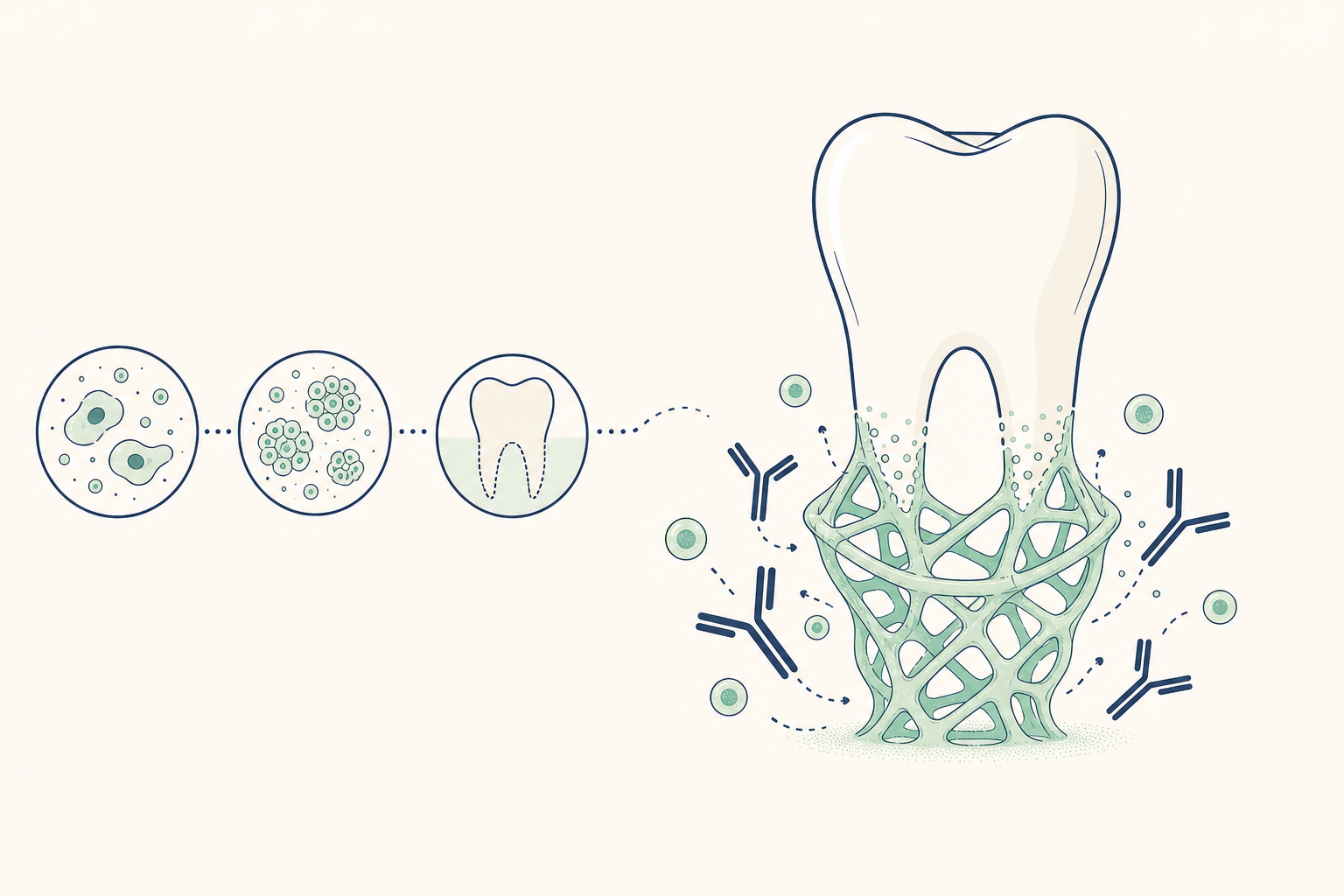
8-slide carousel · storyboard copy
Can adults grow a new tooth?
The short answer is: not as a routine treatment today. Researchers are testing two different ideas: medicines that may activate tooth-development signals, and laboratory-built tissues that may replace parts of a tooth.
Why this is difficult
A natural tooth is a coordinated organ. Enamel covers the crown. Dentin forms most of the tooth. The pulp contains nerves, blood vessels and connective tissue. Cementum covers the root, while the periodontal ligament anchors it to alveolar bone. A replacement must form these tissues in the right shape, position and sequence.
- A filling repairs a defect, not a whole tooth.
- An implant replaces a root with titanium and supports a crown, but it does not recreate pulp or a periodontal ligament.
- A biological tooth must also erupt, contact the opposing tooth and remain cleanable.
The research protocol, in plain language
For antibody-driven regeneration, researchers identify a dormant or underdeveloped tooth bud, block a developmental brake such as USAG-1, and monitor tooth formation with imaging. USAG-1 normally reduces BMP signalling, a pathway involved in tooth development. In animal studies, anti-USAG-1 antibodies stimulated tooth formation, but animal results do not establish safe, predictable human treatment.
- For a bioengineered tooth, dental pulp stem cells and dental epithelial cells are expanded or organised in a scaffold or organoid.
- Materials under study include collagen, gelatin methacrylate hydrogels, hyaluronic-acid gels, decellularised tooth matrix and mineral scaffolds such as bioactive glass or bovine-derived bone mineral.
- The intended sequence is cell preparation, scaffold or organoid assembly, implantation into a prepared site, healing, vascular and nerve integration, and long-term assessment of shape, function and inflammation.
The one rule that matters
A headline is not a treatment. Ask which tissue was regenerated, in which species, and whether a controlled human trial has shown safety and clinically useful function. A mouse tooth, a laboratory organoid and a human replacement tooth are three different milestones.
- A human study of dental pulp stem cells for periodontal defects is not proof that a complete new tooth can be grown.
- A scaffold that forms dentin-like tissue is not proof that it forms enamel, pulp, cementum and a functional periodontal ligament together.
- At present, no lab-grown whole tooth is an established chairside option for UAE patients.
Mythbuster: “The antibody already regrows missing teeth”
The accurate version is narrower. Anti-USAG-1 antibodies have produced tooth-regeneration findings in animal models, and an investigational programme in Japan has moved into early human safety testing. The human study is designed to establish safety and dosing, not to prove that adults can predictably replace a missing molar. Results, eligibility and regulatory approval still determine what becomes clinical care.
- The antibody cannot be assumed to work when the original tooth bud is absent or the jaw has inadequate space.
- It may not recreate the exact anatomy needed for chewing and bite stability.
- Do not delay an evidence-based restoration while waiting for a research programme.
What this means for you now
If a tooth is restorable, preserving its enamel, dentin, pulp and periodontal support is usually more biologically conservative than removing it. Depending on the diagnosis, treatment may involve caries control, a bonded restoration, crown treatment, root canal treatment, periodontal therapy or regenerative endodontic treatment in selected immature permanent teeth.
- If a tooth is missing, current choices include an implant-supported crown, a fixed bridge or a removable partial denture.
- If bone has been lost, guided bone regeneration may use a membrane and a graft material such as particulate bone mineral or bioactive glass. This regenerates supporting bone, not a complete biological tooth.
- Stem-cell injections and tooth organoids remain research treatments outside routine care.
When to see a dentist
Book an examination if you have pain, swelling, bleeding gums, a loose tooth, a broken tooth, difficulty chewing, or a recently missing tooth. The clinical work-up may include a medical history, periodontal charting, pulp sensibility testing, bite assessment, periapical radiographs and, when indicated, cone-beam CT. These findings determine whether the tooth can be saved and which replacement can be safely supported.
- Ask whether the tooth is restorable and whether infection is present.
- Ask what anatomy would be replaced: crown, root, pulp, periodontal ligament or bone.
- If a clinic offers an unapproved regenerative injection, request the trial registration, regulator status, consent documents and published human safety data.
The honest “how soon”
For routine patients, a complete lab-grown or antibody-regenerated tooth is not available today, and no reliable public timetable can be promised. Early human testing may answer whether one pathway is safe. It will take further trials to show predictable anatomy, function, durability and appropriate patient selection. Until then, preserve natural teeth where possible and use proven restorations when replacement is needed.
- Regenerative dentistry is moving from animal studies and laboratory models toward early human testing.
- That is progress, not proof of a finished treatment.
- Dental Nation can assess your current tooth, bone and bite and explain the evidence-based options available now.