Clear aligners vs fixed appliances: efficacy by malocclusion type, not by marketing
We break the evidence down by movement difficulty, predictability gaps, and industry-funded trials.
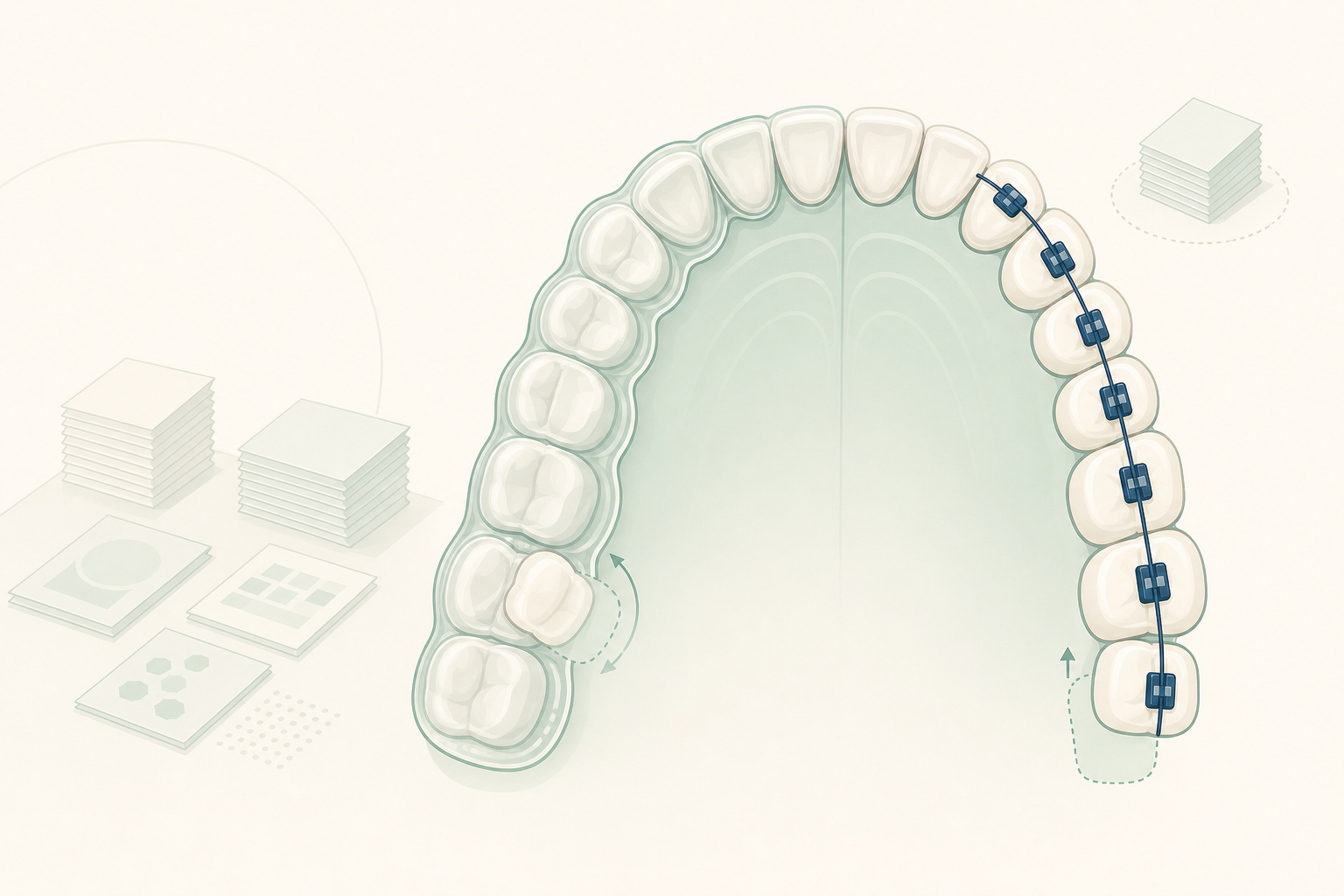
8-slide carousel · storyboard copy
Aligners are not braces in clear plastic
Both systems can move teeth, but they do not control every movement equally. The answer depends on the malocclusion, the required tooth movement, root position, bone support, and patient wear or hygiene.
The movement matters more than the brand
Clear aligners use staged thermoplastic trays to deliver light, programmed forces. Fixed appliances use bonded brackets, archwires, elastomeric modules, and sometimes springs or auxiliaries. Both can correct mild crowding and spacing. Fixed appliances generally provide more direct control when several difficult movements occur together.
- Mild rotations of incisors and premolars can often be managed with either system.
- Large rotations, especially of round premolars, are less predictable with aligners because the tray may lose grip.
- Extrusion, such as bringing a high canine down, is difficult with aligners because the tray tends to lift rather than pull the tooth.
- Root torque, bodily translation, major vertical correction, and complex extraction space closure often need fixed appliances or additional attachments and auxiliaries.
The clinical protocol decides the result
A proper comparison starts with diagnosis, not a software animation. The orthodontist examines the bite, periodontal tissues, facial proportions, and jaw relationship, then uses photographs, scans or impressions, and radiographs when indicated.
- Define the problem: crowding, spacing, overjet, deep bite, open bite, crossbite, rotation, impacted tooth, or skeletal jaw discrepancy.
- Check anatomy: enamel shape, root position, alveolar bone limits, periodontal status, restorations, and temporomandibular symptoms.
- Plan force delivery: attachments and interproximal reduction for aligners, or bracket positioning, archwire sequence, elastics, springs, and anchorage for fixed appliances.
- Review movement clinically at follow-up. A tray that no longer fits or a bracket system that is not progressing requires a revised plan, not automatic continuation.
- Finish with settling, retention, and monitoring. Teeth can relapse because periodontal fibres and surrounding bone remodel after active treatment.
One rule: match the appliance to the hardest movement
If the case contains a high canine that must be extruded, a large premolar rotation, substantial root torque, or major space closure, judge the plan by that movement. A system that handles the easy movements well may still need attachments, elastics, staged refinements, or fixed appliances for the difficult one.
- Attachments can improve aligner grip, but they do not remove biological or mechanical limits.
- Interproximal reduction removes small, planned amounts of enamel to create space. It must be measured and performed conservatively.
- Elastics can add vertical or anteroposterior force, but their effect depends on wear, anchorage, and the diagnosis.
Mythbuster: a digital preview is not a guaranteed result
A predicted tooth path is a treatment plan, not proof that every movement will occur as drawn. Published comparisons commonly find similar outcomes for selected mild cases, while aligner predictability is less consistent for rotations, extrusion, root control, and complex vertical movements.
- Do not treat marketing claims as evidence of superiority across all malocclusions.
- Ask whether a study measured the intended tooth position, the final bite, refinements, and retention, rather than only treatment speed or satisfaction.
- Industry-funded trials can still be useful, but sponsorship may influence the question, comparator, reporting, or interpretation. Look for independent studies, transparent methods, complete follow-up, and clinically meaningful outcomes.
- Fixed appliances are not automatically better for every patient. They may increase plaque-retentive areas and require careful brushing, fluoride toothpaste, and professional monitoring.
Make the choice fit your diagnosis and routine
Choose aligners when the movements are within their predictable range and you can wear each tray as prescribed, remove it for meals, and clean your teeth before replacing it. Choose fixed appliances when reliable three-dimensional control is the priority or when regular tray wear is unlikely.
- For either option, brush twice daily with fluoride toothpaste, spit after brushing, and do not rinse immediately with water.
- Use an interdental brush where the gap allows. Floss remains useful where an interdental brush cannot pass safely.
- With aligners, remove trays for eating and drinking anything other than water, clean the trays as instructed, and do not place hot water on thermoplastic material.
- With fixed appliances, clean around brackets, the gumline, and under the archwire. Limit frequent sugar and follow repair instructions if a bracket or wire breaks.
When to see an orthodontist
Book an assessment if teeth are crowded, rotated, impacted, widely spaced, difficult to clean, or causing an abnormal bite. Seek prompt care for facial swelling, severe pain, trauma, a loose permanent tooth, or a wire causing significant injury.
- Ask: Which movement is hardest in my case?
- Ask: What is the expected limitation of aligners or fixed appliances for that movement?
- Ask: Will attachments, elastics, interproximal reduction, extractions, or temporary anchorage be needed?
- Ask: How will progress be checked, and what happens if a tooth stops tracking or a bracket breaks?
The answer is movement-specific
Aligners can be effective for selected mild to moderate malocclusions, especially when appearance and removability matter. Fixed appliances remain the more versatile tool for difficult rotations, extrusion, root control, major space closure, and complex bite correction. The best treatment is the one whose mechanics match your anatomy and whose routine you can follow.
- Bring your diagnosis, not a marketing promise, into the decision.
- Book a qualified orthodontic assessment in the UAE and request a plan that names the difficult movements, limitations, monitoring, and retention protocol.