Regenerative endodontics vs apexification in immature permanent teeth: the long-term outcome gap
REPs may thicken root walls and allow continued root development, but evidence for true pulp regeneration and long-term survival remains limited.
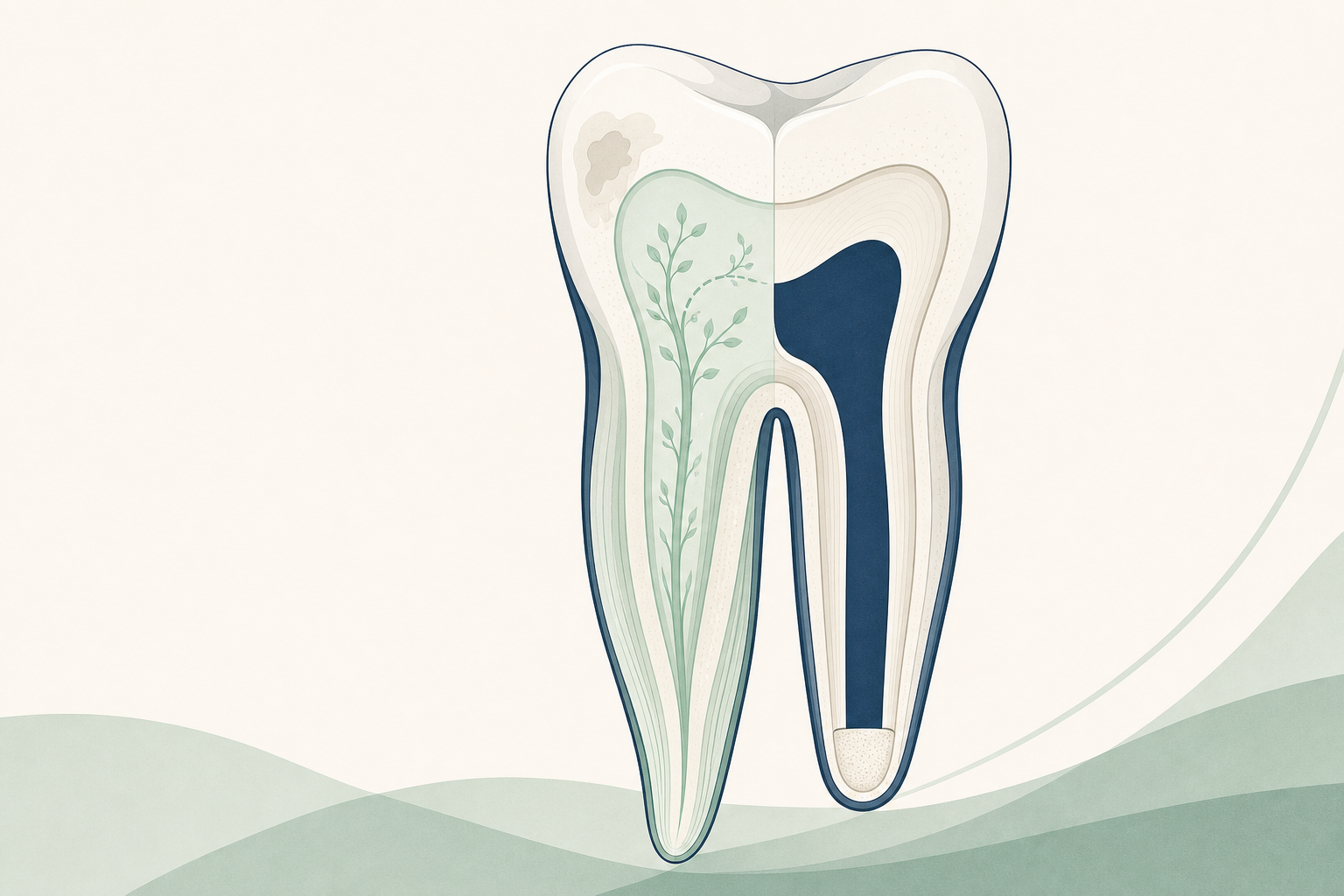
9-slide carousel · storyboard copy
Two ways to save an immature permanent tooth
When a young permanent tooth loses pulp vitality before the root is fully formed, the root may have thin dentinal walls and an open apex. Regenerative endodontic procedures and apexification aim to prevent extraction, but they do not provide the same biological outcome.
- Regenerative endodontics tries to support new tissue formation inside the canal.
- Apexification creates a hard apical barrier so the canal can be sealed safely.
Why the immature root is vulnerable
An immature permanent tooth has an open apical foramen, short root length, and thin dentin around the canal. Without living pulp tissue, root development usually stops. Thin walls increase the risk of cervical or mid-root fracture, while an open apex makes conventional root-canal filling difficult.
- The anatomy includes dentin, cementum, the root canal, the apical foramen, and surrounding periodontal ligament.
- The main long-term goals are infection control, a durable coronal seal, root reinforcement, and tooth survival.
How regenerative endodontics is performed
The dentist first confirms pulp necrosis and an immature apex, then disinfects the canal while limiting injury to stem cells near the apical tissues. A low-concentration sodium hypochlorite solution is used, often followed by EDTA. At a later visit, the canal may be medicated with calcium hydroxide or an antibiotic mixture, then rinsed. Bleeding is induced through the apical foramen to create a blood-clot scaffold, or platelet-rich fibrin may be used. A collagen plug and mineral trioxide aggregate or another calcium-silicate material are placed below a tight coronal restoration.
- The intended mechanism is recruitment of cells from apical papilla and periodontal tissues.
- Possible findings include increased root-wall thickness, additional root length, and resolution of apical inflammation.
- Sensibility tests may remain negative even when the tooth is clinically successful.
- The resulting tissue may be repair tissue, not a normal pulp with organized odontoblasts and nerves.
How apexification is performed
Apexification disinfects the canal and creates an artificial apical stop. The dentist may place calcium hydroxide over time, or place a 3 to 5 mm apical plug of mineral trioxide aggregate or another bioceramic cement. The remaining canal is then filled with a suitable root-filling material, and the tooth receives a bonded coronal restoration designed to reduce fracture risk.
- The apical barrier permits controlled obturation despite the open apex.
- Apexification does not usually make the existing root longer or substantially thicken its dentinal walls.
- MTA and bioceramic materials are alkaline, sealable, and used to form a stable barrier.
- Calcium hydroxide can disinfect, but prolonged use may weaken thin dentin.
The one rule that matters most
A regenerative procedure succeeds only if infection is controlled and the tooth is sealed against reinfection. The coronal restoration is part of the treatment, not an optional finishing step. Follow-up imaging is needed to assess symptoms, bone healing, root development, wall thickening, and possible discoloration.
- Avoid biting hard objects with a structurally weakened tooth until the restoration is definitive.
- Brush twice daily, spit after brushing, and do not rinse immediately with water.
- Use interdental brushes where the space allows; floss remains appropriate where it does not.
Mythbuster: a thicker root does not prove pulp regeneration
An increase in root length or dentin thickness is a favorable structural result, but it does not prove that a normal pulp has returned. Current regenerative procedures are better described as biologically based repair or tissue replacement procedures. Apexification is more predictable for forming an apical barrier, while regenerative treatment may offer a better chance of continued root maturation in selected immature teeth. Neither option guarantees lifelong survival.
- Discoloration can occur, especially with blood products, minocycline-containing antibiotic pastes, or some calcium-silicate materials.
- The decision depends on restorability, the size of the open apex, infection, trauma history, isolation, and the quality of the planned seal.
- Do not choose a procedure solely because an X-ray appears to show new tissue.
What this means for a patient in the UAE
For a restorable immature permanent tooth with pulp necrosis, regenerative endodontics is often considered when continued root development could improve resistance to fracture. Apexification is considered when the priority is a controlled apical barrier or when regenerative conditions are unsuitable. A dentist should explain whether the tooth can be isolated, whether the crown can be restored securely, and what follow-up schedule is available.
- Ask whether the root is immature and whether the apex is open.
- Ask which disinfectants, intracanal medicament, scaffold, and sealing material will be used.
- Ask how discoloration will be prevented or managed.
- Ask what happens if symptoms, apical disease, or root fracture develops.
When to see a dentist
Urgent assessment is needed after dental trauma, persistent pain, swelling, a gum pimple, tenderness to biting, or darkening of a young permanent tooth. These signs can indicate pulp necrosis or apical inflammation even when pain is mild or absent. Diagnosis requires history, examination, pulp and periapical tests, and appropriate radiographs. A specialist in endodontics may be needed for complex anatomy or treatment planning.
- Do not delay because the tooth is not painful.
- A loose or fractured restoration can allow reinfection.
- Children and adolescents may need long-term review because the root and restoration continue to mature at different rates.
The answer in one line
Regenerative endodontics may preserve the possibility of further root-wall development, but true pulp regeneration and long-term survival remain uncertain. Apexification offers a dependable apical barrier without restoring normal root maturation. The best choice is the one that controls infection, preserves the tooth, and can receive a durable seal and restoration.
- Save the tooth early after trauma or symptoms.
- Discuss both options with a dentist or endodontist.
- Book an assessment with Dental Nation to determine whether the tooth is restorable and which protocol fits its anatomy.