Nano-hydroxyapatite vs fluoride for remineralisation: what the head-to-head trials actually show
A wave of n-HAp toothpaste RCTs claims fluoride equivalence; we pool the real effect sizes, flag the funded studies, and grade where the claim holds and where it breaks.
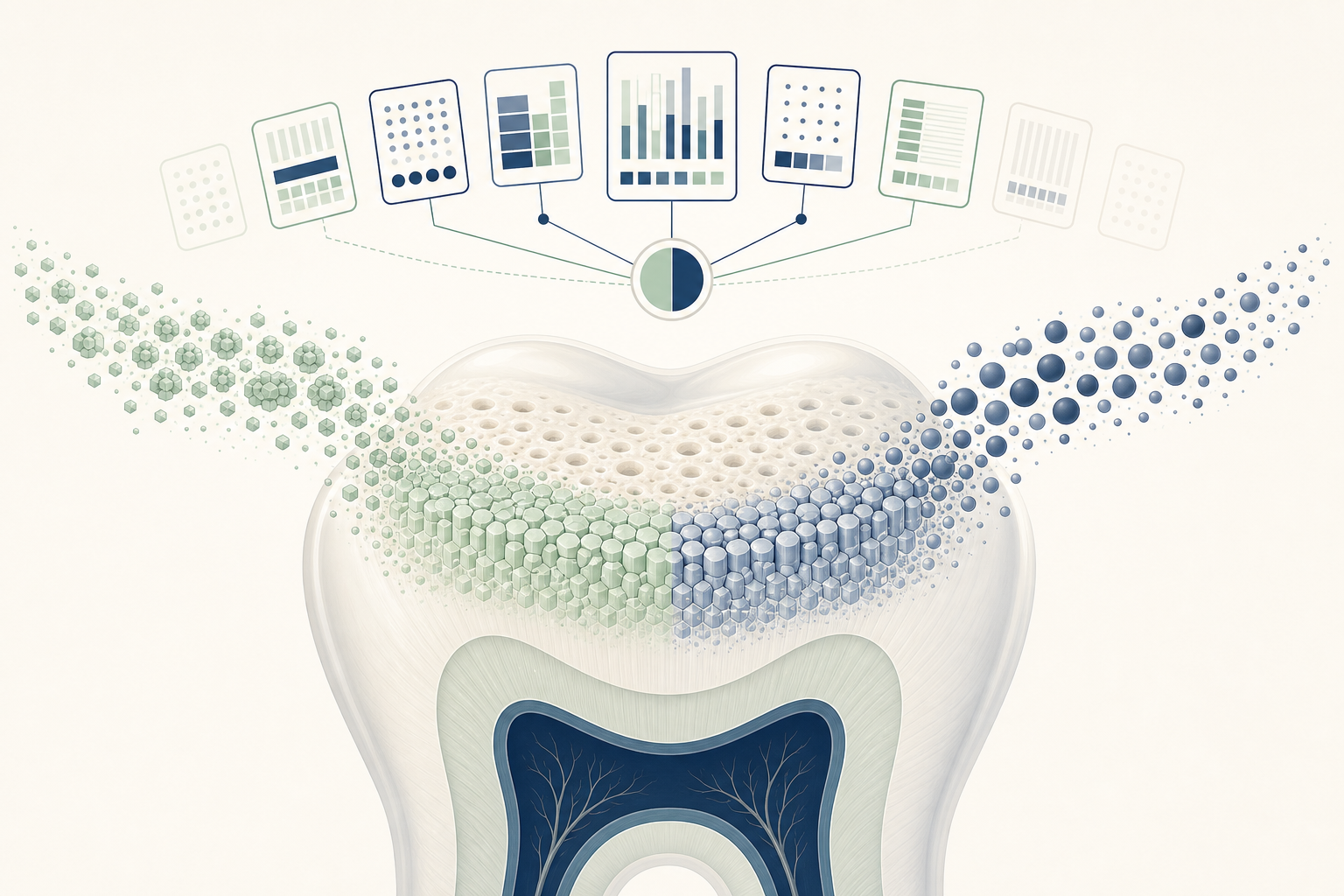
8-slide carousel · storyboard copy
n-HAp is promising. Fluoride remains the benchmark.
Nano-hydroxyapatite may deposit calcium-phosphate mineral into early enamel lesions. Fluoride has stronger, longer-established evidence for reducing demineralisation and caries progression.
- The head-to-head trials are encouraging, but they do not prove that n-HAp is equivalent to fluoride.
- The result depends on the product, concentration, lesion type, age group, brushing routine, and study design.
Remineralisation is not the same as repairing a cavity
Enamel is a mineralised outer layer over dentine. Acid from plaque bacteria dissolves hydroxyapatite crystals, creating subsurface mineral loss and sometimes a chalky white-spot lesion. Saliva supplies calcium and phosphate. Fluoride helps form a more acid-resistant mineral surface and reduces mineral loss during future acid attacks. n-HAp particles can attach to enamel, fill surface defects, and provide calcium and phosphate, but clinical benefit varies between formulations.
- A white-spot lesion may be arrested or partly remineralised if the surface is intact.
- A cavitated lesion cannot be rebuilt by toothpaste alone.
- Neither ingredient replaces plaque control, fluoride exposure, or dietary control of frequent sugar and acid intake.
A practical protocol for early enamel damage
Use a soft-bristled toothbrush and a small amount of toothpaste twice daily. Brush the gumline, outer, inner, and chewing surfaces for about two minutes. Angle the bristles toward the gum margin, where plaque collects around the cervical enamel and exposed root dentine. Clean between teeth daily. Interdental brushes are preferable where the space allows; floss is useful where contacts are tight.
- For routine caries prevention, choose a toothpaste with an established fluoride concentration unless your dentist has given a specific alternative plan.
- Spit after brushing. Do not rinse with water immediately afterwards.
- Do not scrub a white spot aggressively. Abrasion can remove softened surface enamel and expose dentine.
The one rule that matters: match the claim to the endpoint
A trial showing similar mineral change in an artificial enamel slab does not prove similar prevention of cavities in people. A non-inferiority trial can show that a product stayed within a pre-set margin. That is not the same as proving identical biological action or equal performance in every patient.
- Ask whether the study measured surface hardness, white-spot progression, new caries, or filled and missing tooth surfaces.
- Check the duration, sample size, comparator fluoride concentration, adherence, and pre-specified non-inferiority margin.
- Read the funding statement and author affiliations, especially when a branded product is tested.
Mythbuster: “The trials prove n-HAp equals fluoride”
They do not. Some randomised trials in adults, children, and orthodontic patients report no statistically significant disadvantage for specific hydroxyapatite products over the study period. That supports a limited product-specific claim. It does not establish equivalence to fluoride across all formulations, ages, risk levels, lesion types, or longer follow-up.
- n-HAp is not a universal substitute for fluoride.
- A result in primary teeth or orthodontic white spots cannot automatically be applied to high-risk adult root caries.
- Combined n-HAp and fluoride products answer a different question from fluoride-free n-HAp toothpaste.
Make the choice fit your risk
For a low-risk adult with sound enamel, a well-studied n-HAp toothpaste may be a reasonable preference if used consistently. For frequent new cavities, dry mouth, exposed roots, active orthodontic lesions, or previous extensive restorations, fluoride toothpaste has the stronger preventive foundation and may need professional fluoride varnish or prescription-strength fluoride.
- Children should use an age-appropriate fluoride toothpaste unless their dental professional advises otherwise.
- If you choose n-HAp, select a product that identifies the active ingredient and concentration, and do not assume every “calcium” toothpaste contains clinical-grade n-HAp.
- Keep brushing twice daily and reduce repeated sipping of sweetened drinks, including between meals.
When to see a dentist
Book an examination if a white or brown spot persists, feels rough, traps food, becomes sensitive, or appears near a bracket, gumline, or filling. A dentist can dry and inspect the lesion, assess plaque and saliva risk, use bitewing radiographs when indicated, and decide between monitoring, fluoride varnish, resin infiltration, sealant, or restoration.
- Pain, swelling, fever, a bad taste, or a broken tooth needs prompt dental care.
- A toothpaste cannot diagnose whether mineral loss is limited to enamel or has reached dentine.
- Bring the toothpaste packaging if you want the active ingredient and concentration checked.
The answer in one line
n-HAp can help remineralise early enamel changes, and selected trials are reassuring. Fluoride remains the better-established caries-prevention standard. Choose based on risk, product evidence, and a consistent brushing routine, then have persistent lesions examined.
- Brush twice daily.
- Spit, do not rinse.
- Use interdental cleaning daily.
- See a dentist for persistent or changing white spots.