Implant or Bridge
One replaces the root, one spans the gap using the teeth either side. The right choice depends on bone, tooth structure, gum health, time, maintenance and the work those neighbouring teeth must do.
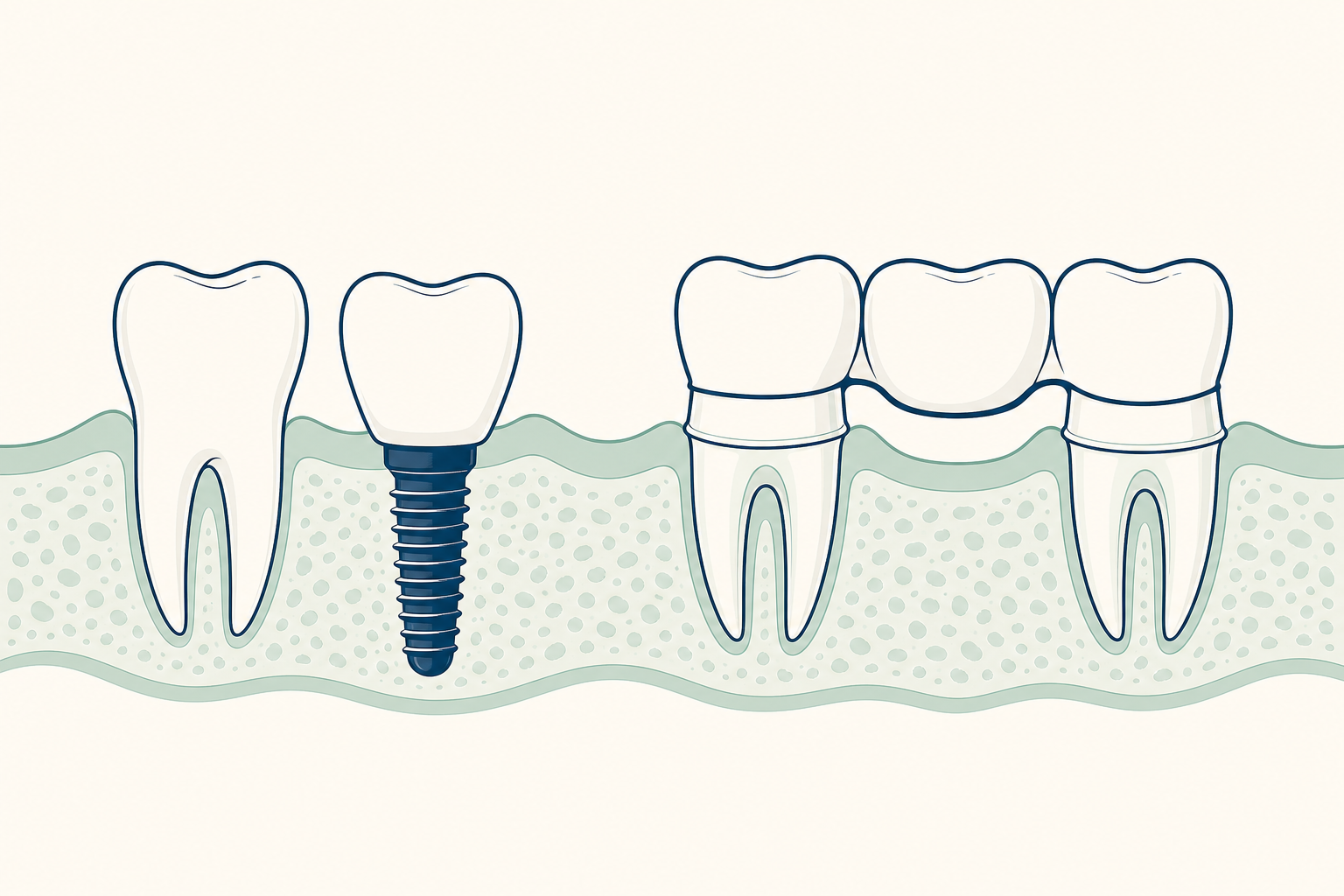
The decision in one sentence
A dental implant replaces a missing tooth with a titanium or titanium alloy fixture placed in the alveolar bone, then supports an abutment and crown. A conventional fixed bridge replaces the visible tooth with a pontic attached to crowns on prepared teeth beside the space. The implant is independent of those neighbouring teeth. The bridge uses them as abutments and transfers chewing forces through their periodontal ligament and roots. That distinction decides much of the treatment. An implant usually asks for surgery, healing time and daily cleaning around the implant crown. A bridge usually asks for irreversible reduction of the abutment teeth and careful cleaning beneath the pontic. Neither option is automatically superior. An implant may be unsuitable where bone volume, systemic health or oral hygiene cannot support surgery. A bridge may be unsuitable where the adjacent teeth are weak, heavily restored or unable to carry the load. The answer comes from examining the missing tooth site, the neighbouring teeth, the occlusion and the patient's ability to maintain the result.
The implant replaces the missing tooth without using its neighbours. The bridge uses the neighbours to carry it.
What an implant actually replaces
An implant restores two parts of a lost tooth: the root and the crown. After local anaesthesia, the clinician raises a flap or uses a guided approach, prepares a site in the alveolar bone and places the fixture. During osseointegration, bone forms close contact with the implant surface. The implant does not have a periodontal ligament, so it does not provide the same pressure feedback as a natural tooth. It is then connected to an abutment, commonly through the implant platform, and restored with a crown made from materials such as zirconia or porcelain fused to a metal substructure. The clinical sequence may include extraction, socket preservation, bone grafting or soft tissue grafting. Immediate placement or immediate provisionalisation is possible only in selected cases with suitable primary stability, intact anatomy and controlled occlusion. The final crown must respect the emergence profile, cleansability and the contour of the interdental papillae. A well-designed implant replaces the root of one tooth, but it does not make the site immune to plaque-related inflammation or excessive biting forces.
Osseointegration gives the implant support, but daily plaque control protects the tissues around it.
What a bridge asks of the other teeth
A conventional bridge uses at least one abutment tooth on each side of the gap, although designs vary. The clinician removes enamel and dentine to create a shared path of insertion and enough space for the retainer material. The prepared teeth are covered by crowns, with a pontic suspended between them. The bridge may be made from zirconia, lithium disilicate, porcelain fused to metal or another laboratory-selected dental material, depending on span length, position, occlusion and appearance. The abutment teeth must have sound periodontal support, sufficient crown height and enough remaining tooth tissue to resist fracture and loss of retention. A tooth that already needs a crown can be a logical abutment. Cutting down an intact tooth solely to support a bridge is a more significant biological cost. The pontic does not have a root. It rests above the mucosa, so the underside must permit cleaning and avoid compressing soft tissue. The bridge restores chewing continuity and can be completed without implant surgery, but the health of the abutments becomes part of the bridge's prognosis.
A bridge can be efficient treatment, but its long-term health depends on the teeth carrying it.
Who tends to suit an implant
An implant tends to suit a patient with a single missing tooth, healthy or treatable gums, adequate alveolar bone and neighbouring teeth that are sound enough to remain independent. It is also useful when adjacent teeth have intact enamel and the patient wants to avoid preparing them. The clinician assesses the ridge width and height, the position of the maxillary sinus or inferior alveolar canal, root proximity, occlusal contacts and the thickness of the facial bone. Three-dimensional imaging may be required for planning. Smoking, uncontrolled diabetes, active periodontitis, poor plaque control and some medical treatments can increase biological or surgical risk. These factors do not create one universal prohibition, but they may require stabilisation or make another option safer. An implant is not a shortcut. It commonly requires a surgical appointment, a provisional phase and a healing interval before the definitive crown. It also needs lifelong maintenance. The best candidate is not simply someone who wants a fixed tooth. It is someone whose anatomy, health, bite and cleaning routine can support an independent prosthetic root.
The strongest implant indication is a healthy gap beside teeth that do not need to become supports.
Who tends to suit a bridge
A bridge tends to suit a patient whose neighbouring teeth already have large restorations, require crowns or have favourable root and periodontal support. It can also suit a patient who cannot undergo implant surgery, does not have enough bone for predictable placement and does not want grafting, or needs a fixed replacement on a shorter treatment timeline. The abutments must be assessed individually. A bridge is a poor choice when one side of the gap is mobile, has a short clinical crown, has advanced attachment loss or has insufficient remaining tooth structure. Long spans place greater bending forces on the retainers and connectors. Cantilever bridges, which rely on support from one side, require particularly careful case selection because the lever arm increases load on the abutment. The clinician checks the occlusion, parafunctional activity, span length and cleansability before preparation. The patient must accept that the bridge is connected. If one abutment develops decay, fracture or periodontal disease, access and repair become more complicated because the units are joined. A bridge is therefore most sensible when the supporting teeth are already suitable participants, not merely convenient neighbours.
A bridge makes most sense when the adjacent teeth benefit from crowns or can safely carry them.
Time, maintenance and biological cost
Implant treatment often takes longer because bone and soft tissue may need to heal before the final restoration is loaded. Extraction, grafting and implant placement may occur in separate stages. The patient may wear a temporary tooth during healing. A bridge usually avoids osseointegration and can often be restored after preparation and laboratory fabrication, although the exact schedule depends on the teeth, gums and laboratory work. Faster treatment does not mean lower biological cost. Implant maintenance includes brushing twice daily with fluoride toothpaste, spitting rather than rinsing afterwards, and cleaning around the crown and abutment. An interdental brush is preferable where the space allows; floss or implant-specific floss can help where it does not. Bridges require brushing of the retainers and cleaning beneath the pontic with an interdental brush, floss threader or other suitable aid. Professional reviews should check plaque, bleeding, pocket depths, mobility, occlusal loading, cement margins and radiographic bone levels where indicated. Both options can fail through biological disease, mechanical fracture, loosening or decay. The patient's daily routine is part of the treatment, not an optional extra.
The real upkeep question is not whether the tooth is artificial. It is whether its margins and underside can be cleaned.
The situation where neither is right
Neither an implant nor a conventional bridge is the right first move when active periodontal disease, untreated decay, acute infection or unstable occlusion has not been controlled. Replacing a tooth before treating the cause can place a new restoration into the same destructive environment. An implant may be inappropriate when the patient cannot tolerate surgery, cannot maintain plaque control or has anatomy that would require a level of grafting and risk they do not accept. A bridge may be inappropriate when the abutment teeth are too weak, mobile or widely separated for reliable support. A removable partial denture can be a more suitable interim or definitive option when several teeth are missing, tissue support is needed or a fixed restoration would sacrifice too much healthy tooth structure. In some cases, leaving a space is reasonable, particularly when appearance, chewing and speech are unaffected and movement is unlikely to create a problem. The missing tooth may also need orthodontic space management before replacement. The correct sequence is diagnosis, disease control, space and bite assessment, then selection of the least harmful option that restores useful function.
When the supporting biology is unstable, treatment should begin with control, not replacement.
A practical conclusion for the missing tooth
Choose an implant when the site can support it, the patient accepts surgery and healing, the adjacent teeth are healthy, and independent replacement offers a meaningful advantage. Choose a bridge when the neighbouring teeth already need full coverage, their roots and periodontal tissues are reliable, and a shorter non-implant route is more appropriate. Do not decide from the crown alone. The clinician should explain the condition of the alveolar ridge, the maxillary sinus or mandibular canal where relevant, the quality of each abutment, the occlusal contacts, the cleaning method and the likely maintenance appointments. A sound comparison also includes what happens if the restoration loosens, fractures, develops decay or loses bone support. For a single missing premolar beside intact teeth, an implant may preserve those teeth from preparation. For a missing tooth beside heavily filled teeth that require crowns, a bridge may use treatment already indicated. For weak abutments and poor bone, neither fixed option may be wise. The answer is therefore not implant versus bridge in the abstract. It is which design creates the least avoidable damage while restoring the patient's actual need.
The fair choice is the one that restores function while asking the fewest healthy tissues to carry an unnecessary burden.
Key findings
- An implant replaces the missing tooth's root and crown independently of adjacent teeth.
- A bridge replaces the crown and uses prepared neighbouring teeth as abutments.
- Implants require suitable bone, surgical planning and lifelong cleaning around the implant crown.
- Bridges require sound abutment teeth and cleaning beneath the pontic.
- Existing restorations, gum health, occlusion, anatomy, treatment time and patient maintenance determine suitability.
- Active disease and unstable support should be treated before either fixed option is selected.
- A removable partial denture, orthodontic management or no replacement may be more appropriate when neither fixed option is suitable.