Should a Wisdom Tooth Come Out If It Does Not Hurt?
Pain is a late signal. The question is whether it can be cleaned.
8-slide carousel · storyboard copy
Not hurting does not always mean it is healthy
A wisdom tooth may need removal even without pain if its position makes it impossible to clean properly or puts nearby teeth at risk.
Why it can become a problem quietly
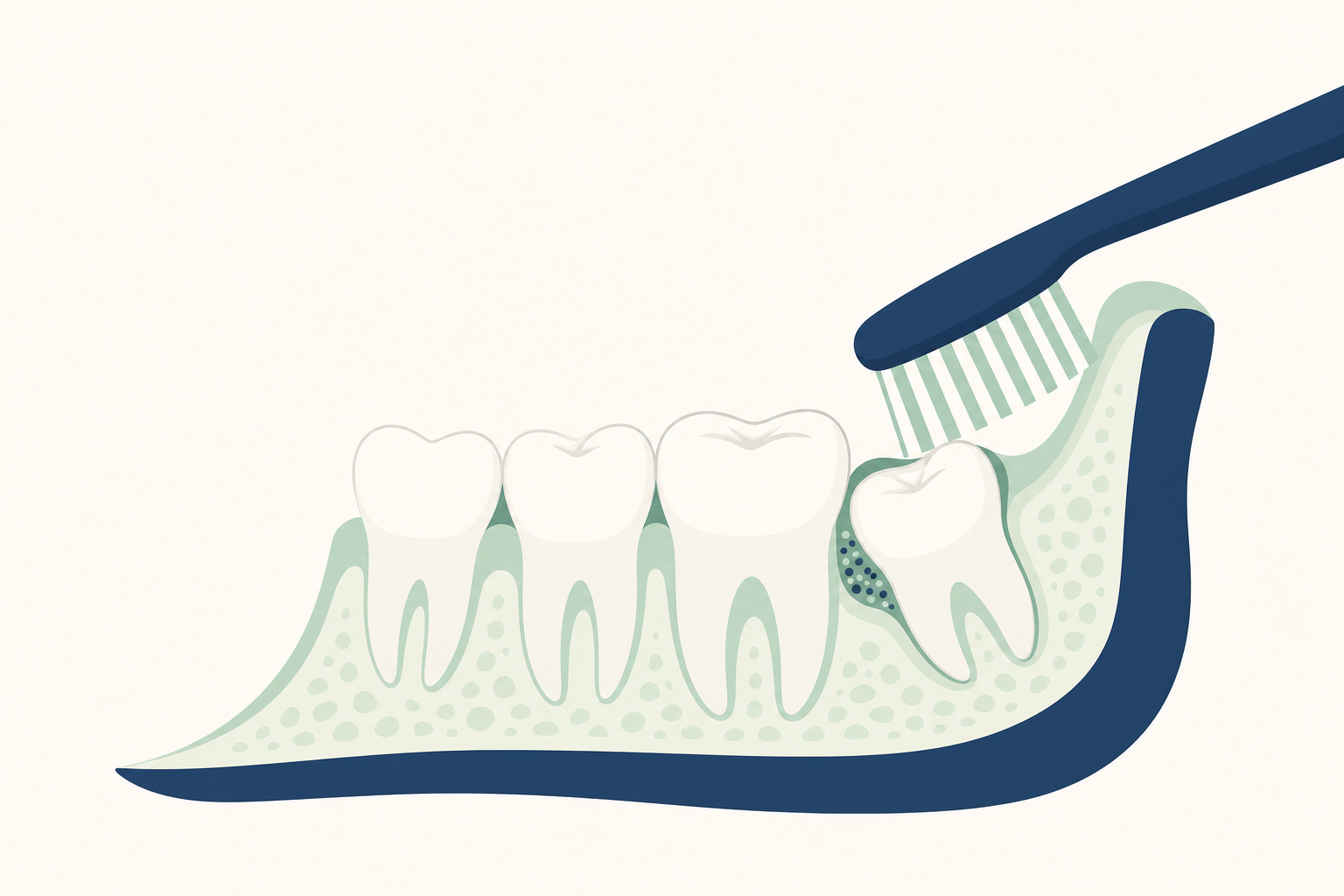
Wisdom teeth are the third molars at the back of the mouth. If one is tilted, partly covered by gum, or trapped against the second molar, plaque and food can collect around the enamel and gum edge. This can cause decay, gum infection, or damage to the second molar before you feel pain.
- A partially erupted tooth can develop pericoronitis, an infection under the gum flap.
- A tilted tooth can trap plaque against the second molar and create a cavity on its back surface.
- A fully erupted tooth may be kept if it is functional, healthy, and easy to brush and clean between.
How the decision is made
The dentist checks the tooth clinically and usually takes a dental X-ray. A panoramic X-ray shows the angle, roots, surrounding bone, and relationship to the inferior alveolar nerve in the lower jaw. The dentist then assesses whether the tooth can be restored, brushed, and cleaned between reliably.
- Look for decay, gum pockets, swelling, food trapping, and damage to the second molar.
- Check whether the tooth is fully erupted or covered by gum or bone.
- Use a bitewing or periapical X-ray when a closer view of decay or roots is needed.
- Remove the tooth when disease is present or its position makes predictable cleaning and long-term maintenance unlikely.
The one rule that matters
Keep a wisdom tooth only if it can be kept healthy. Brush the chewing surface and gumline with fluoride toothpaste, and use an interdental brush where the gap allows. Floss is also suitable when it fits better. After brushing, spit out the toothpaste and do not rinse with water.
- A toothbrush cannot reliably clean a tooth that is partly covered or blocked by the cheek or second molar.
- Cleaning difficulty is a practical risk, not a reason to remove every painless wisdom tooth.
- The decision should be based on examination, X-rays, disease, and cleanability.
Myth: If it does not hurt, it should stay
Pain is often a late sign. Tooth decay, gum pockets, and damage to the neighboring second molar can progress without symptoms. The opposite is also true: a painless wisdom tooth does not automatically need removal if it is healthy, properly positioned, and maintainable.
- No pain does not rule out decay or gum disease.
- An X-ray can reveal hidden problems, but it does not replace the clinical examination.
- Removal is not automatic. The benefit must be weighed against surgical risks and the tooth's condition.
Make the answer fit your tooth
For example, a fully erupted upper wisdom tooth that meets its opposing tooth and can be brushed may be monitored. A lower wisdom tooth tilted forward into the second molar, with a deep gum pocket or repeated food trapping, is more likely to need removal even if it feels normal today.
- Ask: Can I see the whole tooth?
- Ask: Can a toothbrush reach its back and gumline?
- Ask: Can I clean between it and the second molar?
- Ask: Does the X-ray show decay, bone loss, or pressure on the neighboring tooth?
When reassurance is not enough
Arrange a dental examination if the area repeatedly traps food, the gum bleeds or swells, you have bad taste or discharge, limited mouth opening, cheek swelling, fever, or difficulty swallowing. Seek urgent care for facial swelling that affects breathing or swallowing. Even without symptoms, book an assessment if you cannot clean the tooth or if it has not been checked recently.
- The dentist may monitor it with periodic examinations and X-rays.
- If removal is advised, the clinician will explain the procedure, healing, and risks such as dry socket, infection, or temporary nerve symptoms.
- Do not wait for severe pain to assess a difficult-to-clean wisdom tooth.
The short answer
A wisdom tooth does not need to come out just because it is a wisdom tooth, and it does not get a free pass because it is painless. If it is healthy and cleanable, it can often be monitored. If its anatomy prevents cleaning or it is harming the gum or second molar, removal may be the safer choice. Book a Dental Nation examination for an answer based on your mouth and X-ray.
- Healthy and cleanable: monitor.
- Diseased or impossible to clean: discuss removal.
- Painful, swollen, or difficult to swallow: seek dental care promptly.