Growing a Real Tooth Back, Not an Implant, an Actual Tooth
The first human trials of a drug aimed at regrowing teeth are underway. Here is who it is for, what it could do, and why years of testing remain.
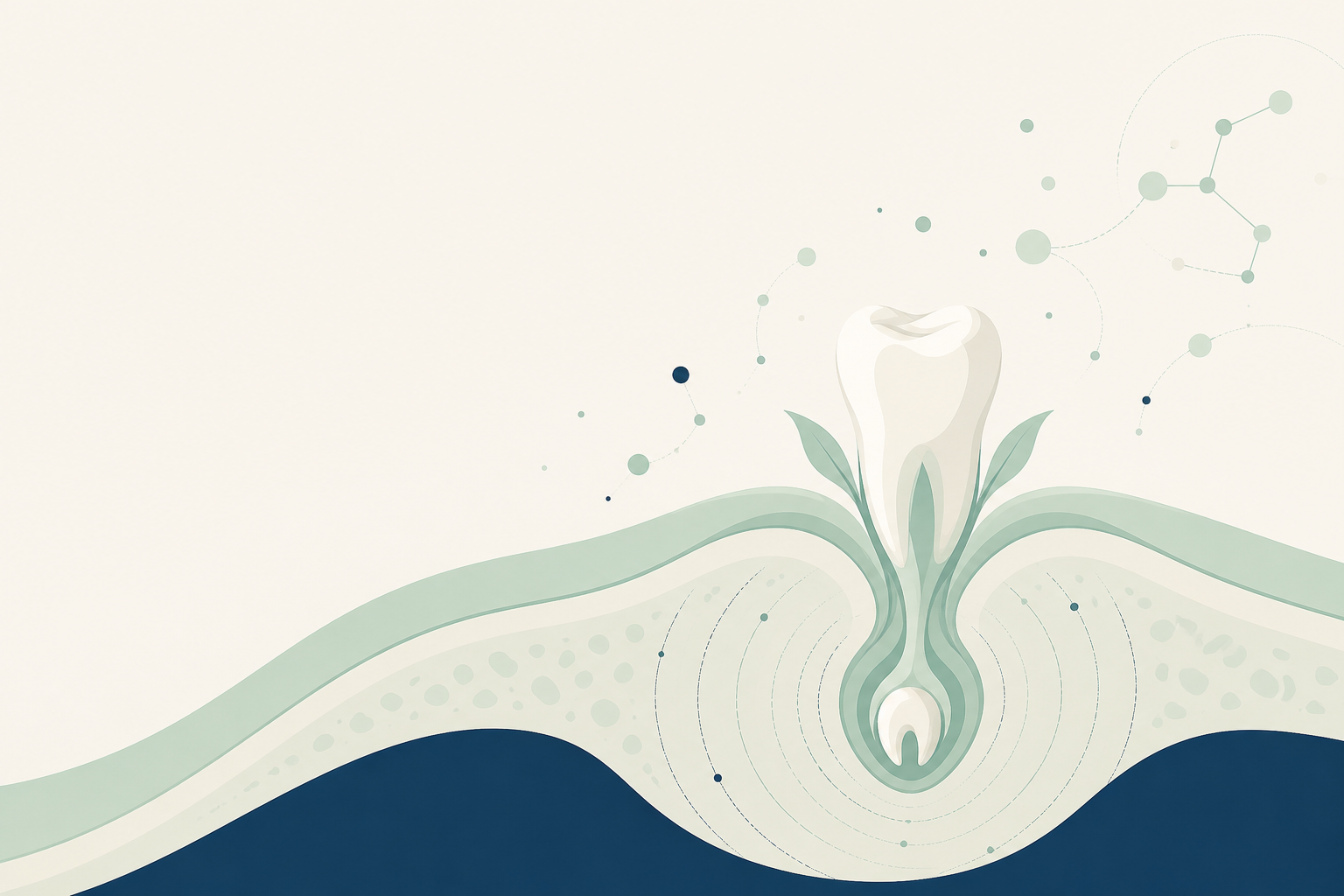
8-slide carousel · storyboard copy
Could medicine grow a new tooth?
Researchers in Japan are testing TRG035, an experimental antibody drug designed to restart tooth development. It is not an implant, filling, crown, or approved treatment.
- The current human study is Phase I.
- Its main purpose is safety, not proving a new tooth will grow.
- It is not available as routine dental care in the UAE.
Why a real tooth would be different
A natural tooth is an organ. It contains enamel over dentin, a pulp with nerves and blood vessels, cementum over the root, and periodontal ligament fibres that attach the root to alveolar bone. An implant replaces the root with titanium and supports a ceramic or other dental crown. It does not recreate pulp or a periodontal ligament.
- Natural teeth form through coordinated epithelial and mesenchymal cells.
- A new tooth would need the correct crown, root, bite position, pulp, ligament, and bone support.
- Replacing a missing tooth today still means options such as an implant, bridge, or removable partial denture.
The protocol, step by step
The registered Phase I protocol is a single-administration study in healthy adults at Kyoto University Hospital. Volunteers are screened, receive the investigational antibody under controlled conditions, and undergo clinical and laboratory monitoring for safety. Researchers then assess whether later studies should include people with congenital tooth absence.
- Step 1: confirm eligibility and record dental and medical history.
- Step 2: examine the mouth and use appropriate dental imaging to document teeth and jaw anatomy.
- Step 3: administer one investigational dose and monitor for adverse effects.
- Step 4: follow participants over time, checking general health and oral findings.
- Step 5: move to studies in people with congenital hypodontia or oligodontia only if safety and biological activity justify it.
The one rule that matters now
Do not wait for tooth-regrowth medicine if you have a painful, infected, loose, or missing tooth. Protect the teeth you have and treat active disease now. TRG035 is experimental, and there is no established timeline for routine use in UAE patients.
- A restorable tooth may need a filling, onlay, crown, or root canal treatment.
- An infected tooth may damage the surrounding alveolar bone and tissues if treatment is delayed.
- A missing tooth can affect chewing, tooth movement, speech, and bite planning.
Mythbuster: this is not a dormant implant
The drug does not manufacture a titanium root or place a ready-made tooth. TRG035 is intended to block USAG-1, a protein that restrains tooth-development signals. In animal research, reducing USAG-1 increased BMP and Wnt signalling and enabled tooth development in selected models. That result does not prove the same outcome in adults.
- The proposed target is USAG-1, also called SOSTDC1.
- BMP and Wnt pathways help regulate tooth-bud initiation and development.
- The antibody would need a viable developmental response in the patient’s tissues.
- Animal findings cannot establish human effectiveness, tooth quality, or long-term survival.
Who might benefit first?
The first intended patient group is people born with too few teeth, such as congenital hypodontia or oligodontia. Their jaws may contain developmental tissue that could respond differently from the jaw of an adult who lost a fully formed tooth to decay, trauma, or gum disease.
- Congenital tooth absence is the research priority because tooth development was disrupted from the start.
- Adults with ordinary tooth loss are a future question, not the current established indication.
- A new tooth would still need assessment of space, opposing teeth, bite, gum health, and bone volume.
- Existing treatment decisions should be based on today’s proven options.
When to see a dentist
Book an examination if a tooth is missing, painful, sensitive, loose, broken, swollen, or difficult to clean. A dentist can identify the anatomy involved using examination, periapical or panoramic radiographs, and cone-beam CT when three-dimensional planning is justified.
- Ask whether the tooth can be preserved before discussing replacement.
- For a missing tooth, review implant, bridge, and removable-prosthesis options alongside bone and gum findings.
- Seek urgent care for facial swelling, fever, difficulty swallowing, or difficulty breathing.
- Do not buy or use an unapproved tooth-regrowth product marketed online.
A real tooth may be possible one day
The science is promising because it targets the biology of tooth development rather than building an artificial root. But the human evidence is still at the safety-testing stage. Until larger controlled trials show that the treatment is safe, predictable, correctly positioned, and durable, implants and other prosthetic options remain the clinical reality.
- Keep brushing twice daily with fluoride toothpaste and spit, do not rinse.
- Use an interdental brush where the gap allows, or floss where it fits best.
- See a dentist early when a tooth changes.
- Follow the clinical trial evidence, not headlines.