The Pill That Might Tell Cavities to Heal Themselves
Tideglusib has shown dentine repair in laboratory and animal studies. Dental use in people remains investigational, so “on the horizon” is the fair label.
8-slide carousel · storyboard copy
A pill for cavities? Not yet.
The molecule in the headlines is tideglusib, a small-molecule GSK-3 inhibitor. It is not a tablet you can take to regrow a tooth, and it is not an approved cavity treatment.
- The target tissue is dentine, not enamel.
- The living dental pulp must still be healthy enough to respond.
- Human dental treatment has not yet established its safety or success.
What would it repair?
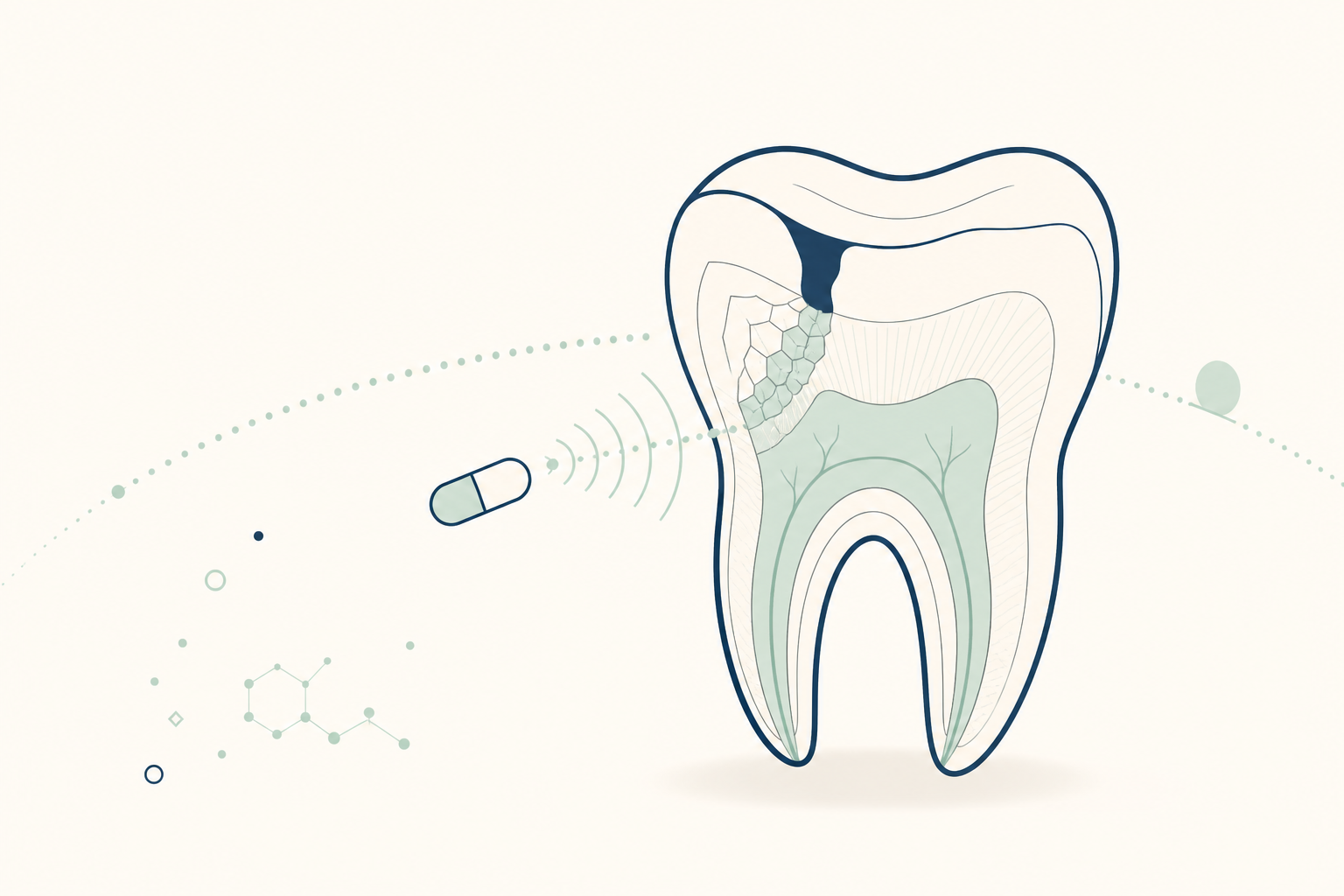
A tooth has an outer enamel shell, a dentine layer beneath it, and a central dental pulp containing nerves, blood vessels, and dental pulp cells. When decay removes dentine, pulp cells can make a thin defensive layer called reparative dentine. That natural response is usually too small for a large cavity.
- Enamel does not contain living cells and cannot rebuild a missing piece of itself.
- Dentine contains microscopic tubules leading toward the pulp.
- If bacteria reach the pulp and inflammation becomes irreversible, a root canal or extraction may be needed.
How the proposed treatment would work
In the research model, the dentist would remove infected tooth tissue, assess whether the pulp remains suitable for vital pulp therapy, place a local carrier containing a GSK-3 inhibitor near the pulp, and seal the tooth tightly.
- Tideglusib inhibits glycogen synthase kinase-3.
- This can increase Wnt/β-catenin signalling, which helps activate repair-related behaviour in pulp cells.
- The cells may differentiate toward odontoblast-like cells that deposit mineralised dentine.
- Research carriers include biodegradable collagen sponges and hydrogels, not a swallowed pill.
- The final seal would still need a dental material such as a calcium-silicate cement, glass ionomer, composite resin, or another restoration selected for the case.
The one rule that matters
A regenerative material cannot replace infection control and a reliable seal. Decay must be removed, the pulp must be assessed, and bacteria and saliva must be kept out after treatment.
- Brush twice daily with fluoride toothpaste.
- Spit after brushing rather than rinsing with water.
- Clean between teeth daily. Interdental brushes are preferable where the space allows, while floss remains useful for tighter contacts.
- Do not wait for a regenerative product to treat an active cavity.
Myth: the drug regrows the whole tooth
The evidence concerns repair of dentine near an injured pulp. It does not show that adults can regrow enamel, roots, a complete tooth, or a tooth lost to decay.
- The strongest early evidence came from cultured cells and rodent teeth.
- Human dental pulp stem-cell studies have mainly been laboratory studies.
- Tideglusib’s previous neurological trials do not prove that a dental application is safe or effective.
- Hydroxyapatite products are not equivalent to fluoride toothpaste, which has established anticaries evidence.
What this means for you
If a dentist finds an early lesion, fluoride-based prevention and remineralisation may help because the tooth structure is still present. If a cavity has formed, treatment depends on its depth, location, restorability, and the condition of the pulp.
- Early enamel changes may be managed with plaque control, fluoride, diet changes, and professional monitoring.
- A dentine cavity commonly needs removal of decay and a restoration.
- A deep but still manageable lesion may be considered for vital pulp therapy using established materials.
- Tideglusib-based therapy should only be considered within properly approved clinical research.
When to see a dentist
Book an examination for toothache, sensitivity that lingers after hot or cold, pain when biting, food trapping, a visible hole, swelling, or a broken tooth. Facial swelling, fever, difficulty swallowing, or difficulty breathing needs urgent dental or medical care.
- The dentist may use visual examination, bitewing or periapical radiographs, and pulp sensibility tests.
- A normal response does not prove that every part of the pulp is healthy, so findings are interpreted together.
- Treatment may involve a filling, vital pulp therapy, root canal treatment, extraction, or monitoring.
The honest answer
Tideglusib is a promising research tool for stimulating reparative dentine from the inside of a living tooth. It has not yet become a routine cavity treatment, and it cannot reverse every type of tooth damage.
- For now, prevention, early diagnosis, and proven restorative care remain the practical options.
- Ask your dentist whether the pulp is healthy, how deep the lesion is, and which established treatment can protect the tooth today.
- Dental Nation can help you understand the evidence and plan appropriate care.