Painless Fillings: How Lasers Are Quietly Replacing the Drill
Laser cavity treatment is real and available in some clinics, but it is a tool for selected cases, not a universal replacement for the drill.
8-slide carousel · storyboard copy
Can a laser remove a cavity?
Yes. Er:YAG and Er,Cr:YSGG lasers can remove decayed enamel and dentin and prepare a tooth for a filling. They are used today, although rotary instruments remain necessary for many cases.
- The laser does not make the cavity disappear.
- It removes diseased tooth tissue by controlled ablation.
- A tooth still usually needs a bonded filling afterward.
Why the sound and vibration can change
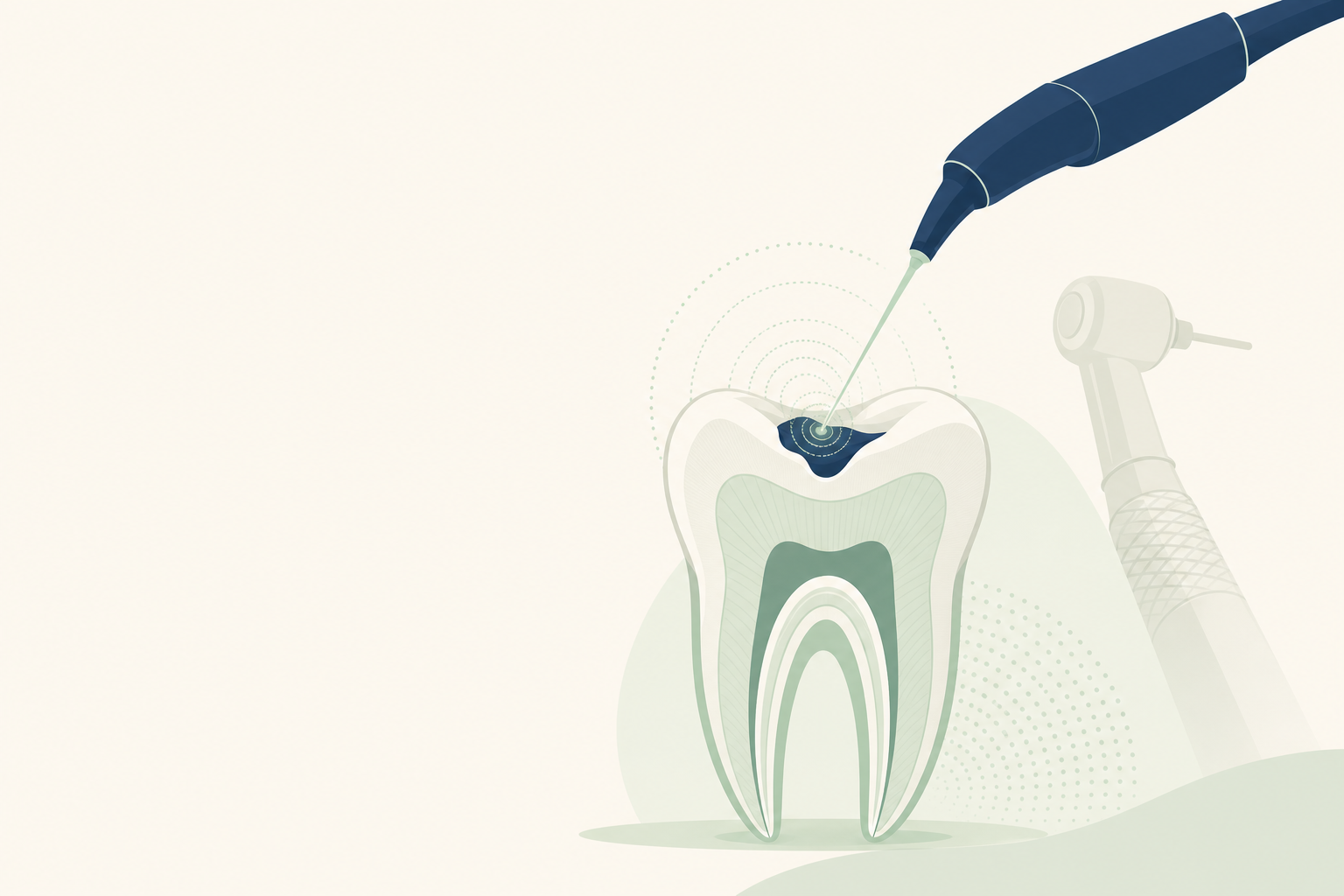
The conventional handpiece cuts enamel and dentin with a rotating bur. An erbium laser delivers short pulses of light that are strongly absorbed by water in the tooth. Water heats rapidly, expands, and ejects tiny particles of mineral and organic tissue. With water spray and correct settings, this can reduce the vibration and high-pitched sound associated with a bur.
- Enamel is the hard outer layer.
- Dentin lies beneath enamel and contains microscopic tubules.
- The pulp contains nerves and blood vessels, so heat and depth must be controlled.
- Laser treatment can still feel pressure, warmth, snapping or occasional sensitivity.
What happens during a laser filling
The clinical sequence is still recognisably a filling appointment. The dentist examines the lesion, confirms its depth with clinical findings and radiographs when needed, isolates the tooth, and selects the laser settings for enamel or dentin.
- Protective eyewear is used for everyone in the treatment area.
- Water spray cools the tooth and carries away ablated particles.
- The laser removes infected or irreversibly damaged tissue while preserving sound structure where possible.
- The dentist checks the cavity with an explorer and visual inspection, then uses a bur or hand instruments if access, old restorative material or cavity geometry requires it.
- The surface is cleaned, conditioned when indicated, bonded, and restored with tooth-coloured composite resin or another clinically appropriate material.
- The filling is shaped, cured with blue light when composite is used, and adjusted so the bite is comfortable.
The one rule that matters
A laser is not automatically safer because it is a laser. The operator must match wavelength, pulse energy, repetition rate, focus, water cooling and exposure time to the tissue. Excess energy can overheat enamel, dentin or the pulp.
- Er:YAG is approximately 2940 nm and Er,Cr:YSGG approximately 2780 nm.
- Both wavelengths interact strongly with water and hydroxyapatite.
- Never look directly at the beam or use a laser without the required eye protection.
- A dentist should stop or change technique if the tooth becomes excessively warm or the patient reports sharp heat pain.
Mythbuster: laser means no drill and no anaesthetic
Not necessarily. Lasers may reduce vibration and may reduce the need for local anaesthetic in some small, shallow lesions, but evidence does not show that every cavity can be treated this way or that every patient will be pain-free.
- Deep dentin decay close to the pulp may still need anaesthetic and conventional instruments.
- Existing fillings, crowns and some restorative materials may not be suitable for laser removal.
- A laser cannot replace diagnosis, moisture control, a proper restoration or pulp treatment when the nerve is inflamed or infected.
- Laser prevention claims are more limited than laser cavity-preparation claims.
When laser treatment may fit you
Laser preparation may be reasonable for a small accessible cavity in enamel or dentin, especially when vibration or drill noise is a major barrier. The decision depends on the tooth, lesion depth, restoration, access and the equipment and training available at the clinic.
- It may suit a small occlusal cavity on a premolar or molar.
- It may be less suitable when decay is deep, hidden between teeth, under an existing restoration or difficult to access.
- Ask which laser is being used, whether it is approved for hard-tissue cavity preparation, and what happens if a bur is needed during the same visit.
- The final filling material and its seal matter as much as the instrument used to prepare the cavity.
When to see a dentist promptly
Book an examination if you have sensitivity that lingers after hot or cold drinks, pain on biting, spontaneous toothache, swelling, a broken filling, food trapping, or a dark or soft area on a tooth. These findings can indicate decay that needs more than a small laser preparation.
- Facial swelling, fever, difficulty swallowing or difficulty breathing requires urgent dental or medical care.
- A dentist may need bitewing or periapical radiographs to assess decay between teeth or near the pulp.
- Do not wait for pain: early decay can be present without symptoms.
- Laser treatment is selected after diagnosis, not used as a substitute for diagnosis.
The practical answer
Lasers can make selected cavity preparations quieter and less vibratory, and they can remove tooth tissue through water-mediated ablation. They are not a universal drill replacement, and they do not remove the need for a dentist, cooling, eye protection or a well-sealed filling.
- If drill noise is keeping you away, tell the dental team before treatment.
- Ask whether your specific lesion is suitable for an erbium laser.
- Keep the tooth clean afterward: brush with fluoride toothpaste, spit rather than rinse, and use interdental brushes where the gap allows or floss where it does not.
- Book an examination with Dental Nation to determine the appropriate treatment for your tooth.