Scientists Are Learning to Regrow Tooth Enamel: The One Thing Your Body Can't Fix on Its Own
Enamel cannot rebuild itself after ameloblasts disappear, but early mineral loss can sometimes be reversed. Here is what researchers can do now, and what remains experimental.
8-slide carousel · storyboard copy
Can enamel really grow back?
Partly, but not in the way headlines suggest. Researchers can guide mineral repair in early, non-cavitated enamel lesions. They cannot yet regrow a complete missing layer of natural enamel on a functioning tooth.
- Early white-spot lesions may be remineralised.
- Chips, holes and worn enamel need restorative treatment.
- Full biological enamel replacement is not available in routine dentistry.
Why enamel is different
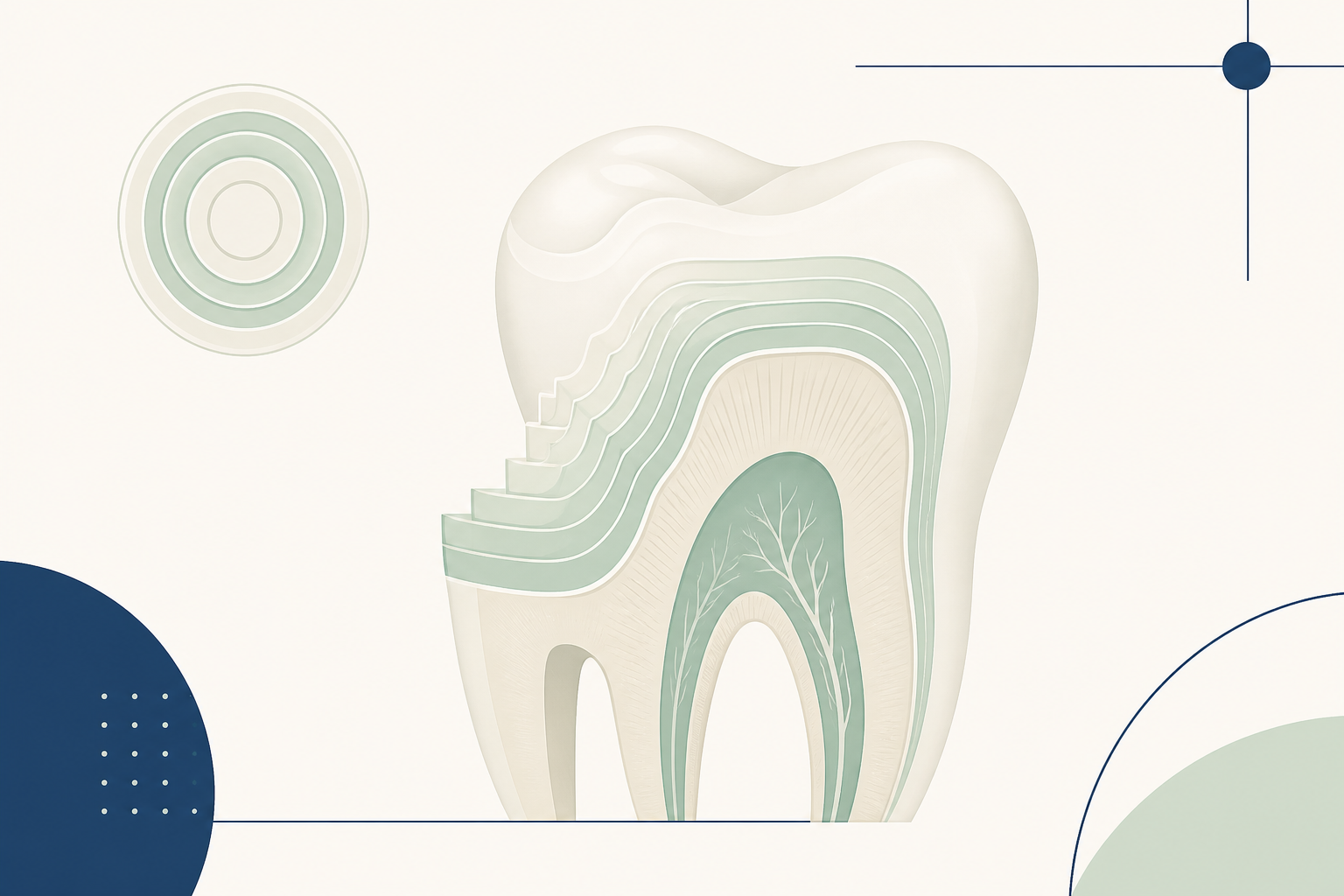
Enamel is the hard outer tissue of the crown. It is made mainly of tightly packed hydroxyapatite crystals arranged in rods. During tooth formation, ameloblast cells build this structure. After eruption, ameloblasts are lost, so mature enamel has no cells that can rebuild a missing section.
- Dentine contains living odontoblasts at its pulp boundary.
- Enamel can exchange minerals with saliva, but that is repair of early mineral loss, not self-growth.
- Acid from plaque or frequent acidic drinks dissolves hydroxyapatite from the surface and subsurface.
What the current protocol can do
For an early, non-cavitated lesion, a dentist first confirms that the surface is intact and identifies the cause of demineralisation. The tooth is cleaned and isolated. A biomimetic material may then be placed into the porous lesion, followed by a mineral source and an oral-hygiene plan.
- Examine the lesion clinically and, when indicated, with bite-wing radiographs or fluorescence tools.
- Clean and dry the enamel, then control plaque, sugar frequency and acid exposure.
- Apply an evidence-based treatment such as fluoride varnish. In selected cases, a self-assembling peptide such as P11-4 may be used to form a scaffold.
- The peptide assembles in the lesion and helps attract calcium and phosphate, supporting new hydroxyapatite formation.
- Review the tooth over time. A cavity, persistent activity or structural loss requires a different treatment.
The one rule that matters
Protect the enamel you still have. Brush twice daily with fluoride toothpaste, spit rather than rinse, and clean between teeth every day. Interdental brushes are preferable where the gap allows; floss is useful where the contact is too tight.
- Use a soft toothbrush and gentle pressure.
- Do not brush immediately after vomiting or a strongly acidic drink. Rinse with water first and wait before brushing.
- Reduce how often teeth are exposed to sugary or acidic drinks and snacks.
- Hydroxyapatite products may support mineral repair, but they are not equivalent to fluoride.
Myth: scientists can print a new tooth surface today
Not yet. Laboratory teams have made enamel-like mineral layers and studied peptides, proteins, hydrogels, calcium-phosphate materials and cell-based methods. The hard problem is reproducing natural enamel's ordered crystal structure, thickness, bonding and long-term resistance to chewing.
- P11-4 has been tested in people with early lesions, including white-spot lesions and early caries.
- Clinical studies report lesion regression or stabilisation, but they do not prove that a missing enamel chip has been regrown.
- The realistic timeline is established prevention and early-lesion treatment now, with complete enamel replacement still requiring further research.
What this means for you
A white spot after braces, a chalky area near the gumline or sensitivity does not automatically mean a filling is needed. The decision depends on whether the enamel surface is intact, whether the lesion is active and how much mineral has been lost.
- Intact early lesion: preventive care, fluoride and monitoring may be appropriate.
- Active or deep lesion: a dentist may add varnish, seal the area or use a minimally invasive restoration.
- Cavity, fracture or significant erosion: remineralising materials cannot rebuild the missing shape; the tooth may need a filling, veneer or crown.
When to see a dentist
Book an examination if you see a new white, brown or rough patch, have sensitivity that persists, notice a chip or catch, or have pain with sweets or cold. Seek urgent care for swelling, fever, facial swelling or difficulty swallowing.
- A dentist can distinguish early demineralisation from fluorosis, erosion, developmental enamel defects and decay.
- Do not scrape or whiten a suspected lesion at home.
- Ask which part is reversible mineral loss and which part is permanent structural loss.
The honest answer
Enamel cannot heal a true hole by itself. But if mineral loss is caught before the surface collapses, modern care can sometimes rebuild mineral within the enamel and stop the process. The breakthrough is real, while a complete replacement enamel layer remains a research goal.
- Protect intact enamel every day.
- Treat early lesions before they become cavities.
- See a dentist for diagnosis, because the correct material depends on the lesion.